
ServiceTitan vs BuildOps: Test contracts and project work together
Compare ServiceTitan and BuildOps using the same maintenance agreement, extra-work request and project change. Includes an evidence-based demonstration matrix.
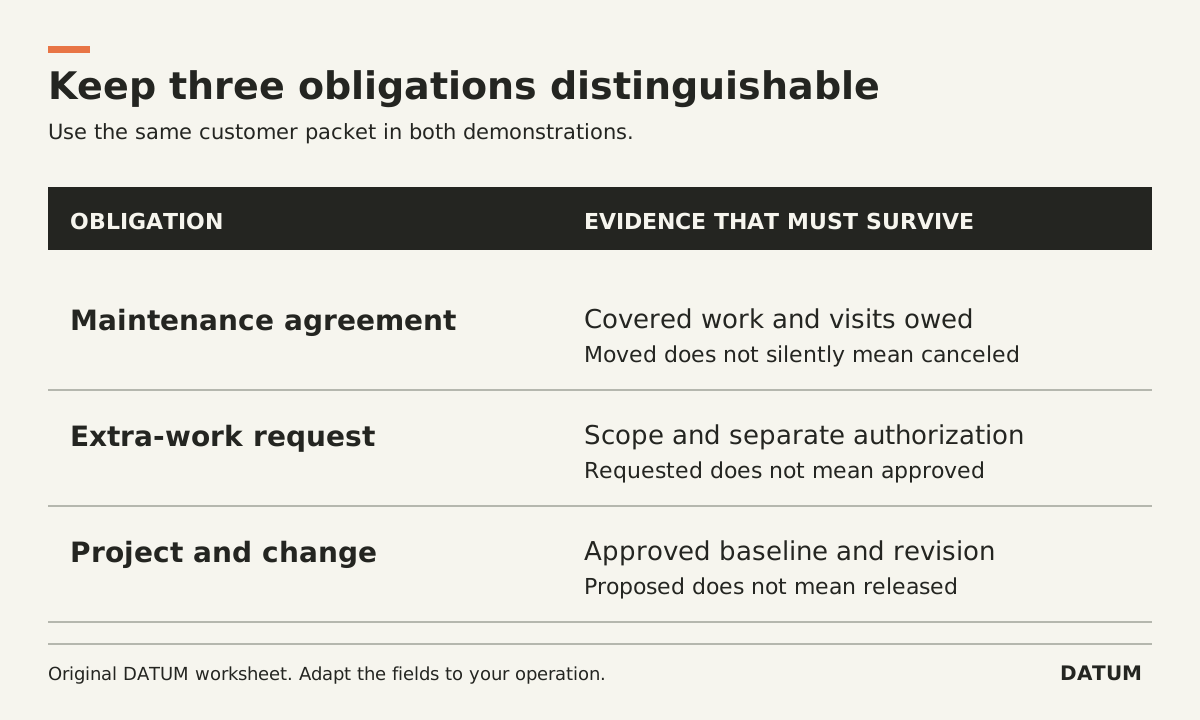
Compare ServiceTitan and BuildOps with a scenario that crosses a maintenance agreement, an extra-work request and a project. A commercial contractor needs to know whether those records remain connected without losing their separate scope, approval and billing rules.
Both vendors describe relevant capabilities. The decision still requires your actual work mix, proposed configuration and evidence from a demonstration. This article does not declare a winner or report hands-on product results.
Establish a fair starting point
ServiceTitan describes software for creating and managing service agreements through execution. Its commercial contractor page separately describes service and construction/project capabilities. Ask the provider to identify which applications and configuration in the proposal supply each part. ServiceTitan agreements, ServiceTitan commercial software
BuildOps describes recurring visits generated from maintenance agreements and presents service agreements alongside project-management workflows. Treat those descriptions as capabilities to investigate, not proof that a specific contract or accounting connection is covered. BuildOps preventive maintenance
Give both providers the same sanitized packet: customer and property structure, relevant equipment identifiers, agreement scope, visit schedule, extra-work approval rule and a small project example. Record the plan, enabled modules, mobile environment and integrations used in each demonstration.
Use one customer with three distinct obligations
Here is an invented evaluation scenario. A commercial customer has two properties under a maintenance agreement. A visit at property A identifies work outside that agreement. Separately, property B has an installation project with an approved scope and a later proposed change.
The demonstration must preserve three answers: what the agreement covers, whether the extra is authorized, and which project baseline applies. A single customer total is not enough to explain them.
Have your own contract and finance owners supply the business rules. The software evaluation should demonstrate their rules; it should not invent contract interpretation or accounting treatment during the meeting.
Compare the evidence at each boundary
| Scenario | Evidence required in ServiceTitan and BuildOps | Question for the receiving role |
|---|---|---|
| Create the agreement | Covered properties/assets, scope and visit obligations | Can dispatch identify what is owed? |
| Move one planned visit | Original obligation and revised schedule | Is the visit still due without duplication? |
| Report out-of-scope work | Linked request distinct from included maintenance | Does sales know what needs approval? |
| Approve the extra | Authorized scope and execution record | Does the crew see the approved version? |
| Record project progress | Phase/work evidence against the project | Can the manager explain what remains? |
| Propose a project change | Proposed versus approved scope and cost basis | Can the office distinguish a request from a commitment? |
| Prepare billing for review | Charge basis with supporting references | Can billing explain agreement, extra and project lines? |
Leave both result columns blank until demonstrated. Record whether an outcome was shown, needs configuration, requires an additional product or remains unresolved. Do not turn “unresolved” into an invented product limitation.
Ask the harder question after the ordinary flow works
Change one detail in the same record: the customer cancels a visit, changes the requested extra before approval, or disputes which project revision was authorized. Use a case your business actually handles and state the rule in advance.
Ask the provider to show the resulting record and the next action. Can the person receiving the work tell what changed? Can the manager inspect the original evidence? If the solution relies on a manual step, record that step and its owner rather than pretending it is automatic.
Then inspect reporting on the same basis. Which costs and revenue belong to the agreement, the extra and the project? Which records are still pending? A margin figure without defined coverage and cutoff cannot settle the comparison.
Include the connection to the financial system
For each candidate, identify what enters the financial system, when it enters and who corrects a mismatch. Do not assume a named integration carries every project field, change or status you need. Ask for a controlled failed-transfer and recovery example in a safe environment.
Separate the operational result from the delivery effort. One candidate may need more configuration, another an integration or process adjustment. Capture those dependencies and support ownership in comparable terms before considering cost.
The landscape recurring-work worksheet offers a smaller example of separating recurring scope from extras and billing. The same distinction matters here even when the commercial work is more complex. Choose based on the demonstrated obligations and the team that will maintain them, not on which vendor lists more adjacent features.