
Decide how a return visit should be billed
Separate incomplete work, rework, possible warranty coverage and new scope before billing a return visit. Keep material use and commercial decisions distinct.
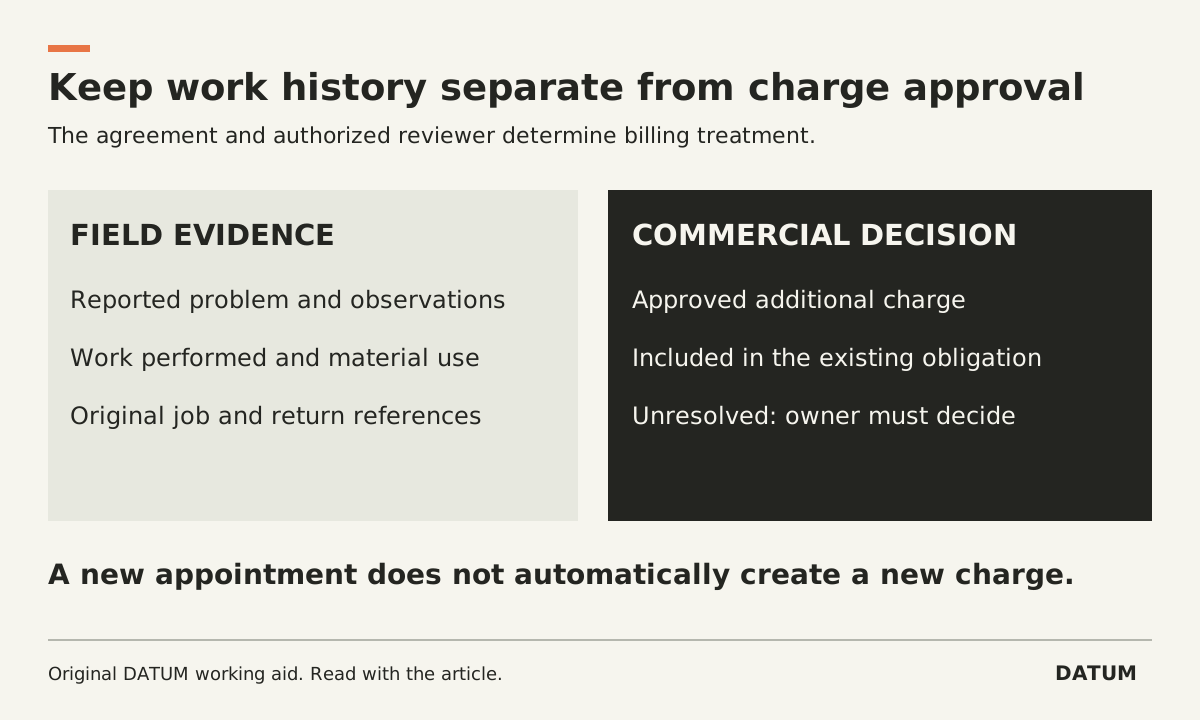
Classify a return visit by its cause and the applicable agreement before deciding whether it creates another charge. A new appointment is an operating event. It is not, by itself, a new billable service.
Keep the technician's observations separate from the commercial decision. The field record should say what happened and what work was performed. The authorized office role determines how the agreement treats that work, including any warranty or rework question that needs specialist review.
Keep the original job in view
Link the return visit to the original job, equipment or service location and the earlier work record. Record the customer's reported problem without immediately treating it as a confirmed diagnosis.
Use this classification worksheet. The examples are hypothetical and do not define warranty rights or standard industry billing policy.
| Possible reason for return | Evidence to inspect | Decision still needed |
|---|---|---|
| Original authorized work remains incomplete | Accepted scope, prior visit and outstanding task | Whether an existing charge or milestone already covers the work |
| A correction to earlier work | Observed condition and reviewed cause | Rework responsibility and customer-charge treatment |
| A possible warranty issue | Relevant agreement, product and service history | Who evaluates coverage and authorizes the response |
| Customer requests an additional service | New requested scope and approval | Whether to prepare a separate offer |
| A different fault is discovered | Diagnosis and relationship to the original work | Whether the work is new scope or belongs to the original obligation |
If the cause is uncertain, use an unresolved category with an owner. Do not force the technician to select “billable” or “warranty” simply to save the visit record.
Preserve time and materials even when the charge is unresolved
Consider an invented repair. A technician returns because a replacement part is malfunctioning. They record the observed failure, remove the part and install another. The office has not yet determined the applicable coverage.
The business still needs the work and material history. A zero customer charge would not mean zero effort or zero material use. Equally, recording a consumed part should not silently settle the customer's responsibility to pay.
In Odoo 19.0 Field Service, the documented product catalog is enabled through Time and Material Invoicing, and recorded products feed the invoice flow. The documentation also describes stock being updated when a task is marked done. Test how your chosen return-visit design records materials while the billing decision is pending. Odoo 19.0 Field Service product management.
This is a requirement to demonstrate, not an assertion that a particular warranty workflow is already configured. Ask what record holds the pending commercial decision and which role can release a charge.
Test for the duplicate charge
Create a test job with an original approved service and a linked return. Prepare the draft billing records for both. The office reviewer should be able to identify which work was already charged, which remains included in the original obligation and which new work has separate authorization.
Then change the classification after the review finds new evidence. Inspect the effect on draft charges, previously issued documents and operating reports. Let the finance owner define the appropriate correction process; do not erase earlier records to make the new explanation look obvious.
A useful test has three outcomes: an additional approved charge, an included return with recorded cost and an unresolved case that stays out of automatic billing. The proposed configuration should make all three distinguishable to the office.
Use the job-completion guide to keep unfinished work visible, and the invoice supporting record to trace the final charge. Close the return only when the work and its commercial disposition each have an accountable owner and a recorded outcome.