
Invoice partial work while the remaining job stays open
Keep completed, previously invoiced and remaining field work distinct. Use a two-run billing rehearsal without hiding the unfinished customer obligation.
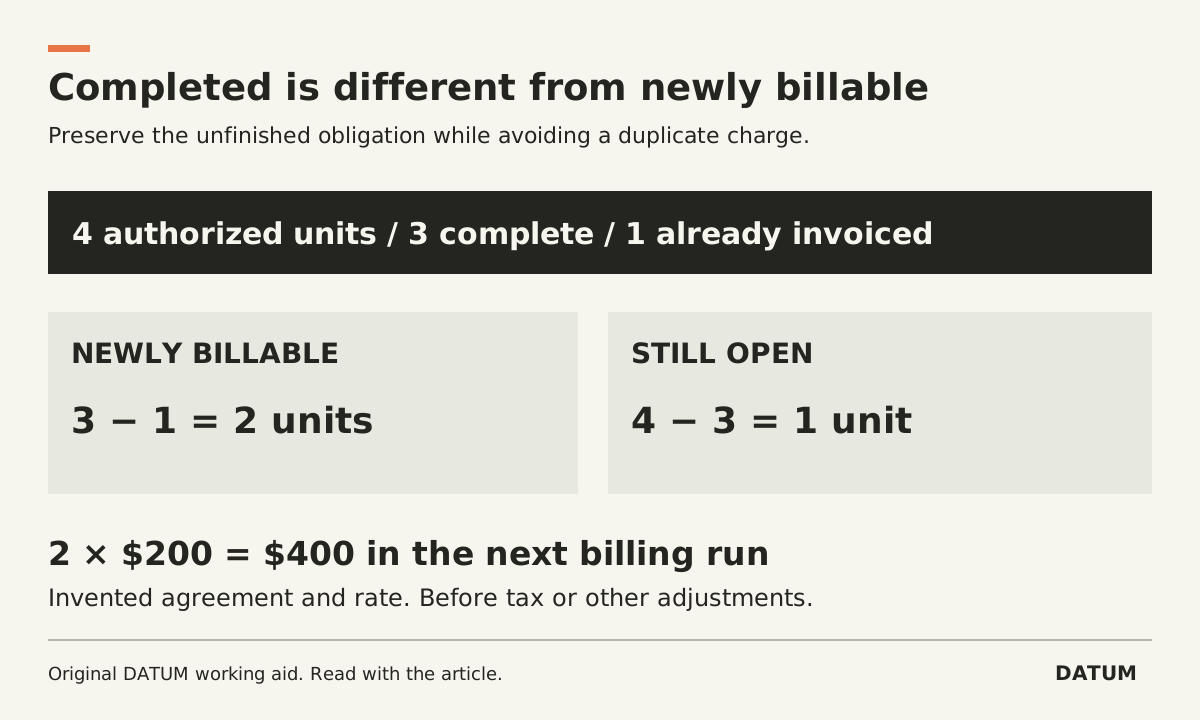
Invoice partial field work only when the agreement and recorded progress establish what is billable now. Keep the unfinished work visible with its own owner and next action. Changing a whole job to “complete” simply to obtain an invoice can hide a remaining customer obligation.
The service manager and billing owner need a shared definition of the portion being invoiced. It may be a quantity, an accepted stage or another agreed basis. The contract and finance owner determine that basis; this worksheet tests whether the operating records preserve it.
Give the billable portion an identity
Consider an invented job to service four separately identified units at one site. Three are completed and accepted; the fourth awaits an approved access window. For this example only, the agreement permits billing completed units separately at $200 each, before tax or other adjustments.
The current billable amount is 3 × $200 = $600. The remaining one-unit obligation is still open. If one of those three units was already invoiced in an earlier approved billing run, only two are newly billable: (3 − 1) × $200 = $400. This example illustrates the reconciliation, not a recommended price or accounting treatment.
| Work portion | Completion evidence | Previously invoiced | Current decision |
|---|---|---|---|
| Unit A | Accepted service record | Yes | Exclude from another charge for the same work |
| Units B and C | Accepted service records | No | Eligible under the example's agreed basis |
| Unit D | Work not performed | No | Keep open; schedule the access window |
| Proposed additional work | Customer has not approved | No | Keep outside the approved billing portion |
A percentage entered into an invoice is not enough unless the underlying agreement uses that basis and someone can explain what the percentage represents.
Match the record design to the invoicing policy
Odoo 19.0 Sales documents ordered-quantity and delivered-quantity invoicing policies, with partial deliveries supported in the delivered-quantity flow. Existing products require their own policy update when the default setting changes. Verify the actual product configuration rather than assuming a changed global setting changed every existing service or item. Odoo 19.0 invoicing policies.
That documentation is not proof that an arbitrary partial field task automatically produces the desired invoice. Have the implementer show which record establishes the completed or billable quantity for your service and how previously invoiced work is excluded.
Odoo's Field Service product guidance connects task materials to invoicing and describes stock updates when a task is marked done. Test that effect as part of the partial-work scenario. A premature done action must not be used merely to force the billing result. Odoo 19.0 Field Service product management.
Rehearse two billing runs and a correction
In a test environment, record partial completion and prepare the first draft invoice. Ask the billing owner to trace every proposed charge to an accepted portion and identify the remaining work.
Then complete the remaining portion and prepare the next draft. Check that the first portion does not reappear as a new charge. Introduce a correction to a previously recorded quantity and have the finance owner demonstrate the approved correction route. Do not delete the original evidence to conceal the sequence.
The dispatcher should still be able to find unfinished work after the first invoice. The billing owner should be able to distinguish completed, invoiced and newly billable portions without reading the entire message history.
Use the completion-evidence guide to define the work state and the return-visit classification worksheet when later work may belong to an existing obligation. Accept the partial-billing design when the work and invoice histories both remain explainable across successive visits.