
Job costing software for custom manufacturing: Test the cost trail
Evaluate manufacturing job costing by tracing estimates, material use, labor and outside work through corrections and closeout. Includes a test packet.
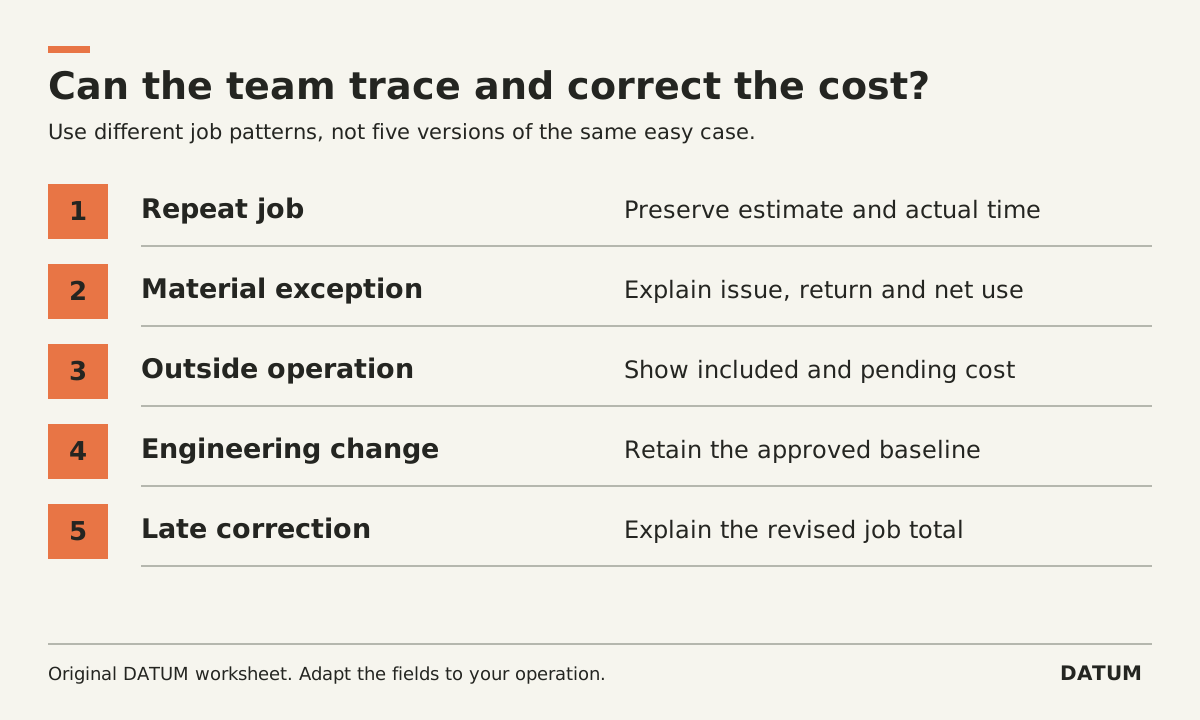
Evaluate job costing software by tracing a cost from its source into the job total, then correcting it and checking the result. A convincing margin dashboard is useful only if your team can explain the estimate, the included actual costs and the work still missing from the report.
Custom manufacturing adds a practical challenge: similar jobs may use different materials, routings, revisions or outside work. Test that variation directly instead of assuming one finished sample proves the costing process.
Build a small packet of different cost situations
Use permitted historical records or synthetic equivalents with expected outcomes defined by the manufacturing and finance owners. You do not need to migrate the whole business to learn whether a proposed setup preserves the necessary evidence.
| Test job | Variation to introduce | What the system must make explainable |
|---|---|---|
| Repeat job | Same specification, different actual time | Original estimate and actual time source |
| Material exception | Additional issue and a later return | Net consumption and the correction trail |
| Outside operation | Supplier work arrives after internal production | Which cost is included and which remains pending |
| Engineering change | Approved revision alters required work | Original versus revised operating baseline |
| Late correction | Cost attribution changes after operational closeout | Authorized correction and updated report |
Five examples are a workshop scope, not a statistical sample. Replace one when a different pattern matters more in your business. Do not select five easy jobs that all test the same path.
Ask for the source behind each number
Pick one reported material amount and trace it to the relevant item, quantity and cost basis. Pick one labor amount and trace it to approved time and the defined rate basis. Pick one outside-work amount and identify its source and job reference.
Ask who can correct each source. A manager should not have to edit an unexplained total merely because the underlying record was assigned to the wrong job. Record whether the proposed system corrects the original event, records a separate adjustment or requires an approved external process.
The accounting owner must determine valuation and reporting treatment. Your demonstration should make that treatment visible and reproducible, including units, cutoff and excluded amounts.
Preserve the estimate before testing actuals
Odoo 19.0 distinguishes expected manufacturing-order cost from real cost. Its documentation also says the MO Cost column updates to match Real Cost after the order is completed. For a historical estimate comparison, require an explicit way to preserve the approved baseline rather than assuming those completed-order columns retain it. Odoo 19.0 manufacturing-order costs
That is one concrete test for an Odoo Enterprise proposal, not a claim that Odoo cannot support the desired analysis. Confirm the release, applications and report design in the proposed environment, especially if the provider is using an Online SaaS version.
Apply the same question to every candidate: when a rate, BOM or scope changes later, what happens to the original estimate? Ask to see the answer in the record rather than infer it from a report title.
Test a correction and a late cost
In an invented example, a job currently shows $1,000 of material cost. A reviewed return represents $100 on the same selected cost basis. The expected net in this simplified test is $900, with both the original issue and return explainable. This is test arithmetic, not an instruction to post a particular accounting entry.
Now introduce an outside-work record that arrives after the shop has marked the job complete. Have the provider show whether the job report changes, which period is affected and how the reviewer knows it changed. The approved process may involve a controlled reopening, a separate financial correction or another method. Establish the requirement with your accounting owner before choosing the mechanism.
A system that displays a revised total without a usable explanation has not passed the cost-trail test.
Score evidence separately from implementation work
For each case, record the result as shown, unresolved or dependent on specified additional work. Capture the source record, report and responsible role. List configuration, integration or custom reporting requirements separately from the demonstrated operating outcome.
Use the job-cost variance worksheet only after you have established that the baseline and actual records are complete enough to compare. It explains the arithmetic; this evaluation proves whether the proposed software can supply and preserve the inputs.
Keep the test packet after selection. It becomes a useful regression set when the report, integration or release changes, and it gives the next reviewer a way to challenge a number without reconstructing the original sales demonstration.