
Trace material through two subcontractors
Map a product through successive subcontractors without inventing warehouse receipts. Reconcile partial transfers, intermediate stages and unfinished work.
When material moves from one subcontractor to another without returning to your warehouse, design the record trail around that physical path. The system must distinguish where the material is, what stage it has reached and which purchase or production obligation the next movement satisfies.
Do not record a fictional receipt into your warehouse simply to connect two orders. First draw the real route and ask the implementation team to demonstrate how the proposed Odoo configuration represents it.
Give each stage a clear identity
Consider an invented process: your company supplies blanks to a machine shop, the machined pieces go directly to a coating supplier, and the coated parts finally arrive at your warehouse. The company must determine how its agreements treat ownership, loss and acceptance at each stage.
Use this movement worksheet before choosing routes:
| Event | Physical evidence | Record relationship to preserve | Open question |
|---|---|---|---|
| Blanks sent to machine shop | Quantity, lot and dispatch confirmation | Supply movement to the first subcontract operation | Who confirms receipt? |
| Machining completed | Accepted quantity and stage identity | Input consumption and resulting intermediate product | What happens to rejected pieces? |
| Machine shop sends to coater | Handoff confirmation and quantity | Movement from first external location to second | Who owns material in transit? |
| Coating completed | Accepted output and inspection evidence | Intermediate input to finished product | Who accepts the coating result? |
| Finished parts received | Actual receipt, lot and quantity | Final output back to the company's stock | Which remaining obligations stay open? |
These are design requirements, not a claim that standard routes automatically cover the entire chain. Whether an intermediate item needs its own product identity, BOM and tracking policy depends on how the business must plan, inspect and reconcile that stage.
Use the documented flows as building blocks
Odoo 19.0 documents basic subcontracting, company resupply and company-purchased components dropshipped from a vendor. It distinguishes those flows by how the subcontractor obtains components. Odoo 19.0 subcontracting.
The documented resupply example sends company components to one subcontractor and receives the finished output. Its stock-move history provides a way to inspect the recorded component consumption, output and movements. That example does not, by itself, prove the configuration for two successive subcontractors. Odoo 19.0 resupply subcontracting.
Likewise, a vendor shipping purchased components directly to a subcontractor is a documented dropship flow. Do not equate that automatically with your first subcontractor producing an intermediate item for the second. Ask for the exact product, purchase, location and route design. Odoo 19.0 dropship subcontracting.
Reconcile a partial transfer
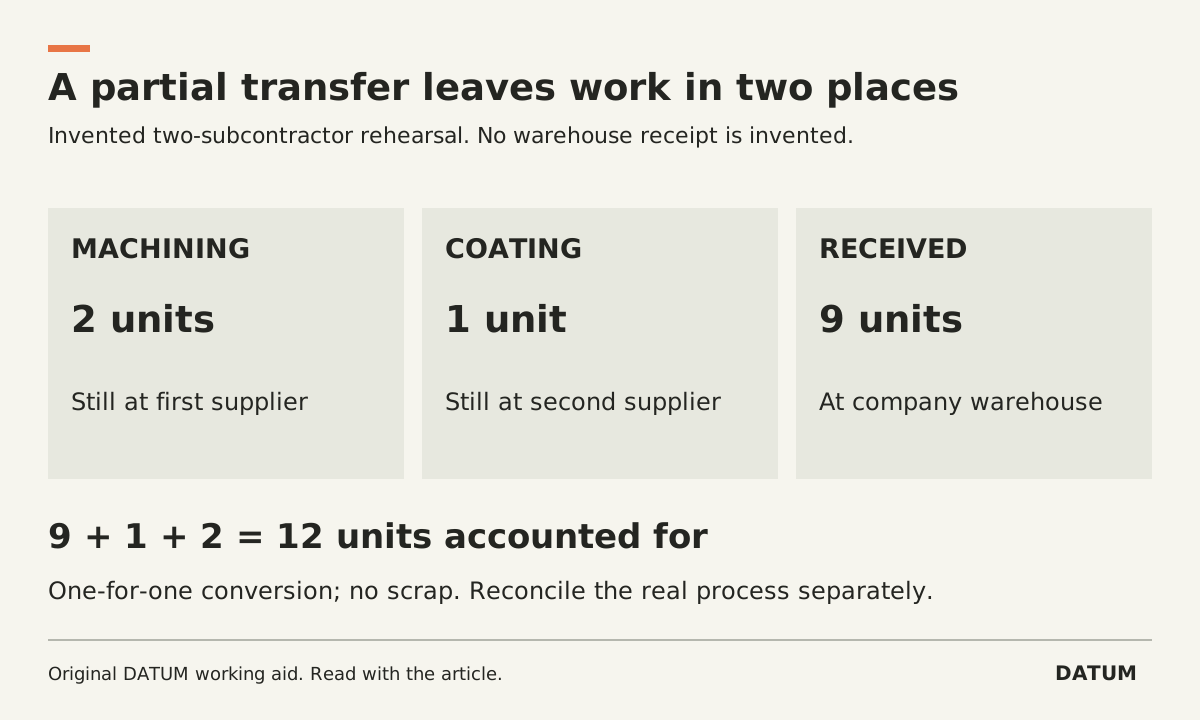
In the fictional rehearsal, send 12 blanks to machining. Ten accepted pieces proceed to coating and two remain at the machine shop for an identified reason. If nine coated parts reach your warehouse and one remains with the coater, the physical status is nine received, one at coating and two at machining: 9 + 1 + 2 = 12 units.
That simple count assumes one-for-one conversion and no scrap. State those assumptions. If the real process consumes several inputs per output, or includes scrap, use a quantity reconciliation appropriate to that process instead.
Now ask purchasing what each supplier still owes and inventory where every company-tracked unit is recorded. Ask finance to review how the configured costs and outstanding obligations are represented. Do not infer the accounting treatment from the physical count.
Repeat with a rejection and a returned intermediate item. Preserve references across the correction so the final product remains traceable to the original material. The material-ownership guide helps settle the procurement distinctions first.
Accept the design only after another person can follow the records through both suppliers and explain the unfinished work. A diagram with the right arrows is a useful specification; the saved test transactions establish whether the configuration follows it.