
Jobber vs Housecall Pro: follow the recurring work into billing
Compare Jobber and Housecall Pro with quote changes, recurring visits, extras and invoices. Test documented handoffs in the exact plans being proposed.
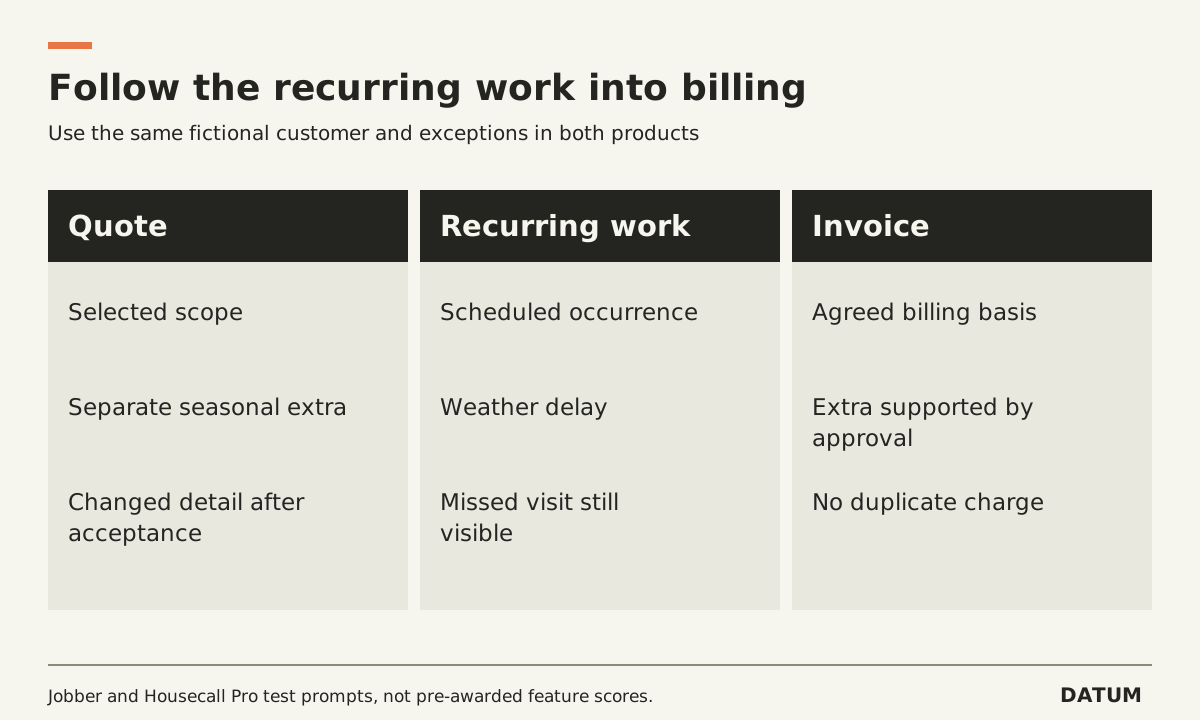
Compare Jobber and Housecall Pro using a quote with a change, a recurring visit with an exception and the resulting invoice. That sequence tests whether the office can distinguish what the customer accepted, what the crew performed and what should be billed.
This is a practical comparison for the exact plans and configurations offered to your business. It is not a ranking of every feature, and it does not assume that one vendor's terminology means the same thing as the other's.
Start with the accepted work
Use a fictional property-maintenance customer who wants a recurring visit plus a separately priced seasonal task. Ask each vendor to prepare the proposal, record the customer's selection and create the resulting work.
Then change one detail after acceptance. Ask which record is revised, how the accepted scope remains identifiable and what the crew sees. Record the proposed subscription, user role and any additional feature required.
Housecall Pro's current documentation permits configuring multi-option estimates so a customer can approve one or multiple options. It also explains that multiple approved options are not automatically combined into one job; each approved option must be copied to a job, or the relevant line items manually combined. That is a concrete handoff to inspect when your business sells separate extras. See the multi-option estimate guide.
Do not assume Jobber handles the same case identically. Ask its demonstrator to perform the scenario and preserve the resulting quote-to-job evidence. The comparison is incomplete if one side is documented and the other is merely assumed.
Separate the visit schedule from the billing schedule
Jobber documents recurring jobs for repeating visits and for work billed on a schedule. Its guide distinguishes visit-based billing from a fixed amount per invoicing period. Test the mode that matches your agreement, because an extra visit and a fixed monthly charge are different billing situations. See Jobber's recurring-job guide.
Housecall Pro documents service-plan views for unscheduled visits separately from recurring revenue and amounts due. Use those views to ask how the office identifies paid-for work that still needs to be scheduled. See the Service Plans dashboard guide.
These documented features are starting points for the evaluation. Confirm availability and limits in the proposed account rather than inferring that every subscription includes them.
| Test case | Show in each candidate | What the office must explain |
|---|---|---|
| Recurring visit | Scheduled occurrence and assigned crew | Which work is due this week? |
| Weather delay | Moved visit with the original obligation preserved | Has the visit moved or been canceled? |
| Seasonal extra | Separate approval and work record | Is the extra included in the recurring charge? |
| Missed visit | Outstanding work visible after the scheduled date | Who owns rescheduling or another resolution? |
| Draft invoice | Charge traced to the agreement and work | Why is this amount due? |
Test a change to the recurring arrangement
Introduce a customer who wants to change the billing frequency of an active arrangement. Ask each vendor to show the supported route and what happens to the remaining work and history.
Housecall Pro's Service Plans FAQ says an accepted active plan's billing frequency cannot be directly changed; the documented route requires canceling it and creating another. Evaluate that consequence in a test account. Do not change a real customer plan merely to explore the behavior.
For either product, ask who checks that no remaining visit, credit or pending amount has been lost in the transition. The required evidence should follow your actual agreement and accounting policy.
Keep the comparison useful after the demo
Have your office owner repeat one scenario without the presenter. Record the help needed and the exceptions still unresolved. Then compare the total proposed scope, including setup, migration, training, integrations and support ownership.
The landscaping recurring-work guide goes deeper on the distinction between routine service and extras. The contractor invoice packet defines the records billing needs at the end.
Choose based on the work your people can demonstrate in the proposed setup. Keep a missing essential handoff visible even if the product performs well on unrelated features. That gives you a decision record you can use during implementation and acceptance.