
Use one disputed order to decide whether to investigate ERP
Check operating need, process agreement, data access and delivery capacity before an ERP investment. Compare a repair, a connection and a broader change.
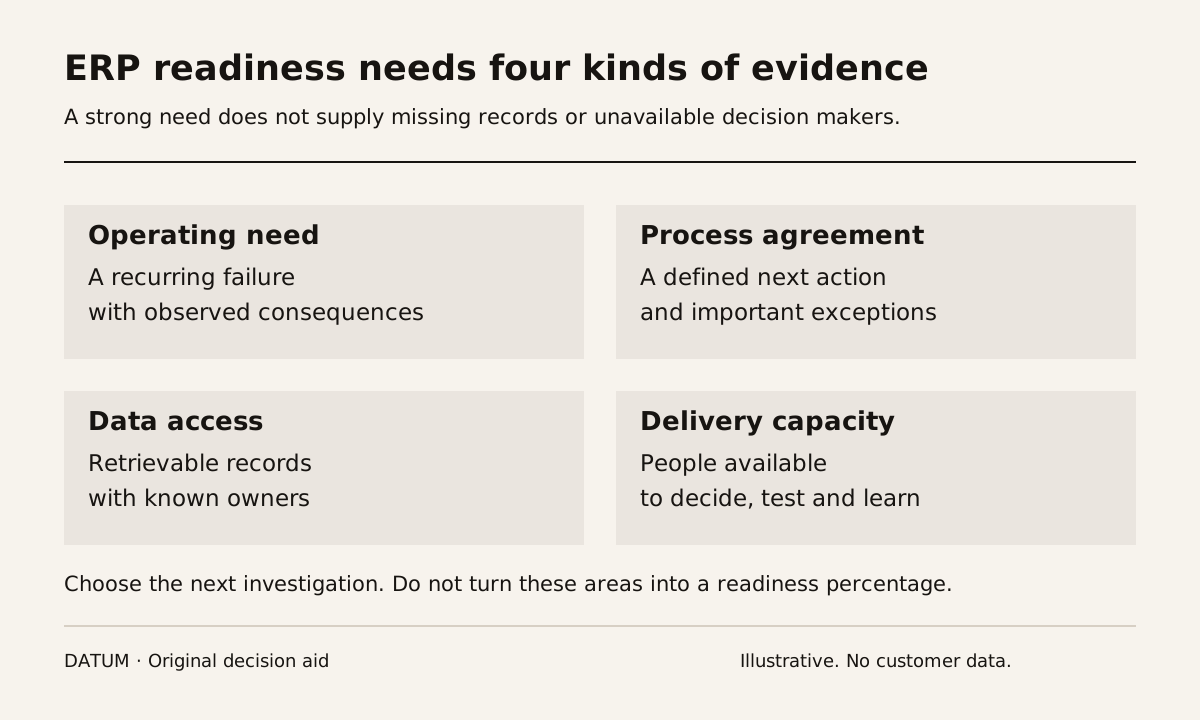
Investigate an ERP when important operating decisions repeatedly depend on reconciling records across teams, and the business is ready to define how those records should work. Headcount, revenue or the number of spreadsheets alone cannot establish that replacing software is the next sensible step.
ERP describes software connecting business processes such as accounting, purchasing and supply chain work. That scope explains why it can address cross-team record problems, but also why an implementation needs business decisions beyond choosing an application. Oracle's ERP overview.
This readiness check helps an owner decide whether to investigate, repair a narrower problem first, or wait while an essential dependency is resolved. It is an original diagnostic, not a statistically validated score or a sales qualification rule.
Choose a disputed order rather than a perfect one
Pick a recent job or order where someone questioned the status, quantity, cost or next action. Bring the underlying records. Ask each person to explain which record they trusted and why another person could not use it.
For a fictional assembly business, sales may promise a delivery date from a spreadsheet while production schedules from an emailed revision. Purchasing has ordered against the earlier component list. The first useful finding is the conflicting accepted revision, not “we have too many spreadsheets.”
Use the job-tracing method to reconstruct the sequence. If the disagreement disappears when the team names a record owner and a change rule, test that correction before expanding the software scope.
Record evidence in four separate areas
Do not collapse the following worksheet into a single readiness percentage. A serious gap in one area can determine the next action.
| Area | Evidence that supports an ERP investigation | Evidence that calls for earlier work |
|---|---|---|
| Operating need | The same cross-team record problem recurs and its consequence is documented | One isolated issue or an undefined frustration |
| Process agreement | Owners can state the intended action and important exceptions | Teams disagree about the business rule |
| Data access | The required records can be retrieved and their owners identified | Critical history is inaccessible or unexplained |
| Delivery capacity | Named people can decide, test and train within a defined first scope | Nobody has available time to accept the result |
Write a concrete observation in every row. “Billing had to ask the supervisor which revision was approved” is evidence. “Our systems are outdated” is a judgment that still needs investigation.
Keep the business consequence separate from an estimated financial benefit. If nobody has measured time spent resolving the problem, record the cases and begin measuring. A plausible saving is not a baseline.
Compare three next actions
The first option is a process correction inside the current tools. Give one person ownership of the accepted revision and define how a change reaches the next team. Use a few representative orders to see whether the correction holds. Record what remains difficult.
The second option is a bounded connection or configuration change. This may fit when one system already owns reliable records but another team cannot receive them. Test identifiers, corrections and failed transfers. Do not count a successful first transfer as proof that the connection can be maintained.
The third option is an ERP investigation covering the connected workflow. It becomes a stronger candidate when the remaining problem crosses several operational records and the first two options would preserve conflicting ownership or require repeated reconciliation.
These options are not a mandatory maturity ladder. A critical system failure may require a different response. The point is to state why the proposed scope follows from the observed problem.
Define the first release before asking for a company-wide quote
Name the workflow, people, records and acceptance result. A fictional first release might cover one order type from accepted demand through delivery evidence, with other operations left in their current tools under explicit boundaries.
Check the data and training work as carefully as the application list. Odoo, for example, distinguishes implementation services from its software subscription. Purchasing access does not establish that process decisions, migration and user preparation are included. Odoo pricing and implementation boundaries.
If the main unresolved problem is sales follow-up, use the CRM-versus-ERP worksheet to narrow the investigation. If the cross-team need is clear but nobody can review the work, resolve that capacity dependency before accepting a launch promise.
Finish with a decision memo short enough to revisit: the recurring failure, the evidence, the chosen next action, the person responsible and what would make you reconsider. That memo gives a provider a real problem to address and gives your team a way to judge whether the proposed ERP scope is necessary.