
Phased ERP rollout or one cutover: map the overlap
Choose an ERP rollout sequence by tracing open orders, shared data and temporary handoffs. Give every transition task an owner and an end condition.
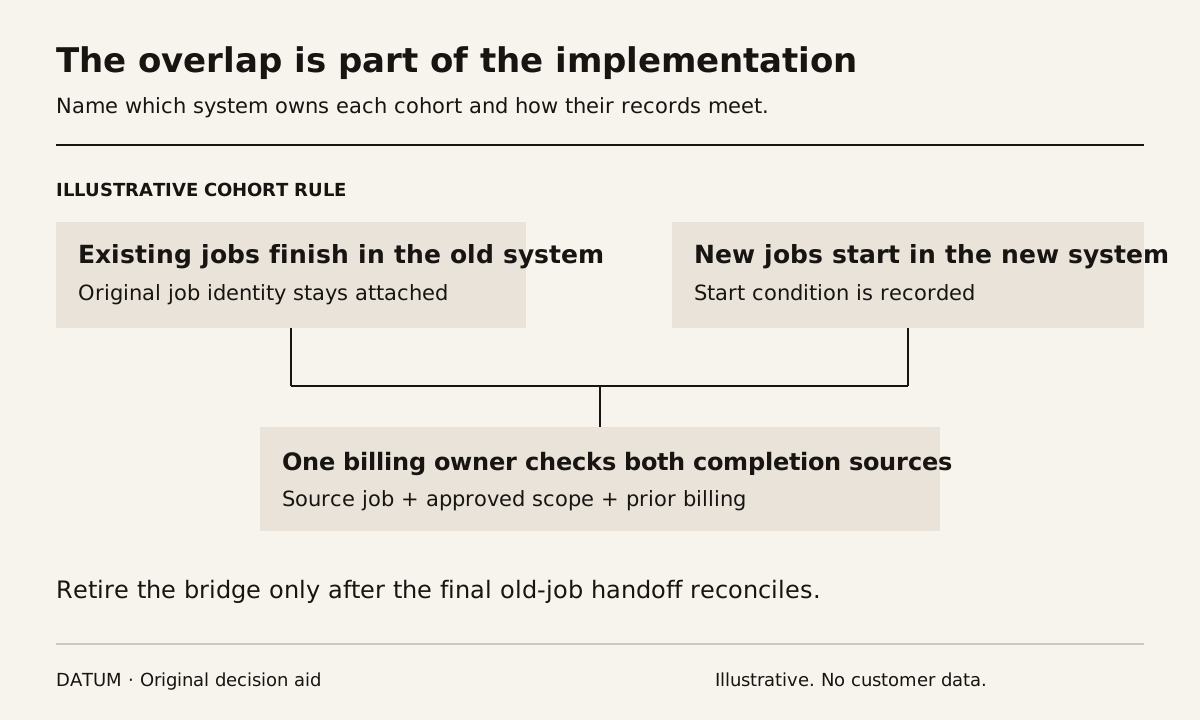
A phased ERP rollout is workable when the business can explain every record that crosses between the old and new systems. One cutover is workable when the team can prepare and verify the connected work together. Choose between them by examining those transition obligations, rather than assuming that smaller releases always mean less risk.
The awkward period is the overlap. A quote might originate in one system while fulfillment runs in another. If nobody owns the mapping, a phased plan can exchange one large migration for weeks of unresolved handoffs.
Draw the overlap before choosing the sequence
Take an order that will remain open across the proposed launch date. List the records it needs: customer, accepted scope, delivery, material movement, invoice and payment reference. Mark where each will be created and maintained during the transition.
The record-ownership worksheet is useful when two systems will coexist. For a rollout decision, add a start date and an end condition to each temporary arrangement.
| Transition question | Phased release must explain | One cutover must explain |
|---|---|---|
| Open orders | Which system completes each order cohort | How every in-scope open order is transferred |
| Shared customers | Which system owns updates during overlap | How the accepted customer set is loaded |
| Material movements | How old and new work use the same stock evidence | How movements around the cutoff are reconciled |
| Billing | How completion reaches the billing owner | How opening and new work remain distinguishable |
| Corrections | Which record is corrected and how the other learns | Which pre-cutover history remains accessible |
| Recovery | How a failed phase stops without losing cross-system work | How the team stops or restores the agreed operating state |
These are design questions, not a ranking. A phased release confined to a separate site with verified operating independence may have fewer dependencies than splitting purchasing and inventory at the same warehouse. Verify the separation with records instead of relying on the organization chart.
Trace a transaction that straddles launch
Consider a fictional contractor that creates new jobs in the replacement system from Monday but finishes existing jobs in the old system. Its office still prepares all billing in one accounting system.
That proposal creates two completion sources. Ask the billing reviewer to identify the source job, approved extras and prior invoices for one job from each cohort. Then change the customer address on an old job and inspect how the billing destination obtains the correct information.
The transition needs an explicit rule for jobs that are reopened, split or rescheduled. A calendar date alone cannot classify them. Define whether the original job identity determines ownership and who can approve an exception.
Count the temporary work as part of the rollout. A daily reconciliation, manual transfer and exception queue may be a reasonable choice, but each needs a person and an end condition. Do not let a temporary bridge disappear from the implementation estimate.
Rehearse the chosen boundary with actual identifiers
Odoo 19 documents External IDs for updating imported records and linking related records, and warns that imports are permanent. A migration rehearsal should therefore test the planned identifiers and relationship mapping before the live sequence. Odoo 19 import documentation.
Use the migration rehearsal controls for counts, rejected rows and readback. Include an order on each side of the boundary, a shared customer update and a failed transfer. Have the next person continue from the saved evidence.
A successful first load does not prove that the overlap can run for the planned period. Repeat the next day's permitted changes and reconcile them. If the bridge depends on someone remembering an exception from yesterday, improve the record before accepting the sequence.
Make the decision conditional on evidence
Compare the two options using their unresolved dependencies, internal workload and recoverability. Do not score a missing critical handoff as merely one low number among many completed tasks.
Record the chosen sequence, the transaction boundary, temporary owners, acceptance evidence and conditions that would require revisiting the choice. For each temporary interface, name the event that retires it. That event might be completion of the last old-system job, followed by a reconciled billing handoff.
A phased rollout earns its place when the overlap is manageable and testable. A single cutover earns its place when the connected records and people can be ready together. The transition map supplies the evidence for that judgment.