
Which workflow should your ERP rollout start with?
Choose a complete first ERP workflow with ready data, a business owner and a tested boundary to existing systems. Includes candidate and eligibility worksheets.
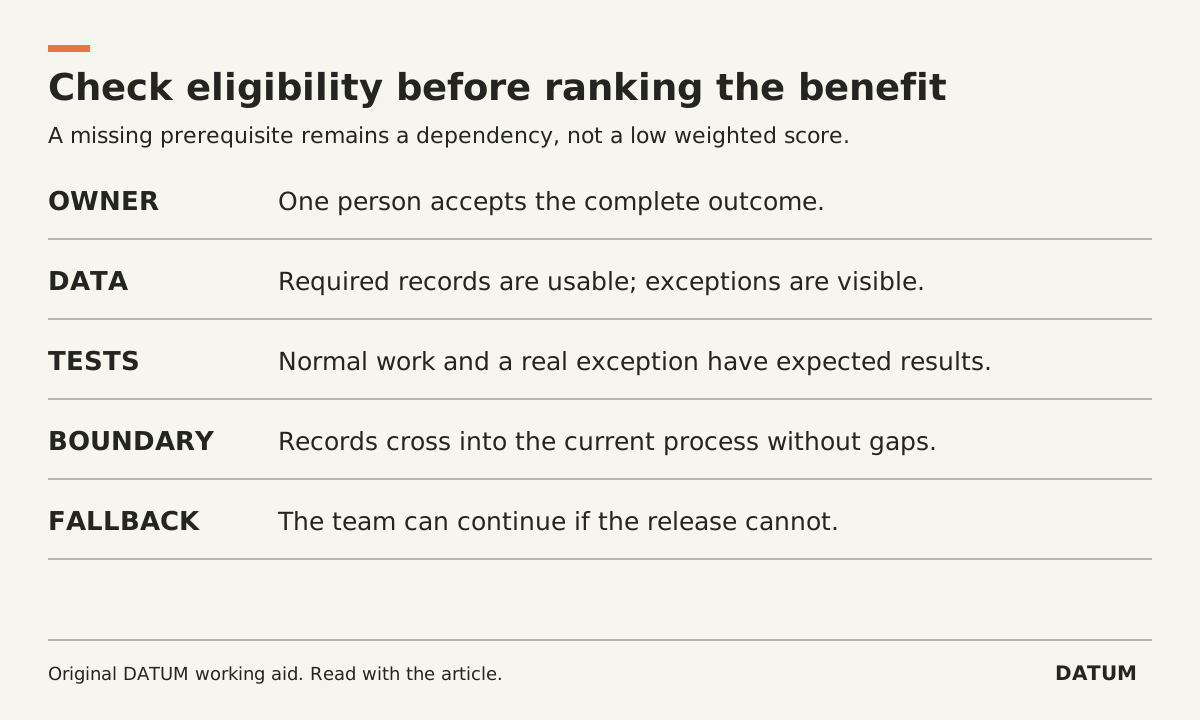
Start an ERP rollout with a complete, bounded workflow whose prerequisites are ready and whose result a business owner can accept. The first scope should have a clear beginning, a usable end and a manageable connection to the work that stays in existing systems.
This decision comes after the business has chosen to proceed with ERP. It is about sequencing the rollout, not making the original software business case. Selecting the smallest module on a price list does not necessarily create the smallest workable release.
ERP connects business processes and shared data across functions. That connected scope is described in Oracle's ERP overview. The selection method here is an original operating worksheet for deciding which part to introduce first. Oracle: What is ERP?.
Define the finished result before naming the module
Compare candidate workflows in terms of the work people will complete. “Purchasing” is too broad. “Create an approved purchase order for stocked parts, receive the parts and leave the bill reviewer a traceable receipt” is specific enough to examine.
Likewise, “field service” might mean only dispatch visibility, or it might include time, material, completion evidence and billing. State which result the first release must achieve and where the remaining process continues.
For an invented company, three candidates might be:
| Candidate | Completion evidence | Critical prerequisite | Boundary to manage |
|---|---|---|---|
| Purchase to receipt for stocked parts | Accepted receipt tied to the approved order | Usable product, supplier and unit records | Bill review remains in the current accounting process |
| Service job to reviewed invoice draft | Office can explain each proposed charge | Approved scope and consistent field records | Customer billing stays with its current authorized process until cutover |
| One manufacturing product family | Completed order with explainable consumption and output | BOM, stock, operations and planning inputs | Other product families keep their existing flow |
These are examples, not a recommended sequence for every business. The candidate with the most visible pain may still depend on data or decisions that are not ready.
Apply eligibility gates before a score
Ask five questions of each candidate:
- Is there one accountable business owner for the complete outcome?
- Are the required master records usable, with unresolved exceptions identified?
- Can the team define and execute a normal case and a meaningful exception?
- Can work cross the boundary to the current process without an unexplained duplicate or gap?
- Is there a feasible fallback if the release cannot continue?
A “no” is a dependency to resolve, not a reason to hide the candidate. Record what would make it eligible and who owns that work. Do not let a high benefit score compensate for an absent owner or an impossible handoff.
Among eligible candidates, compare the business consequence, implementation effort, available user capacity and what the first release will teach about later work. Use evidence or explicit estimates. An arbitrary numerical score can conceal uncertainty more effectively than a short explanation.
Draw the temporary boundary
For the selected workflow, name the system that owns each record during the first release. Identify the identifier used to connect records across systems and the person who handles a failed handoff. State when the temporary arrangement ends.
In the fictional purchasing candidate, the team must be able to explain how a receipt reaches the existing bill-review process and how corrections are communicated once. That boundary is part of the first scope, even if no software integration is being built yet.
Test the boundary with a partial receipt and a correction. The repair, integrate or replace guide helps evaluate the connection if the current handoff cannot support it.
End the selection discussion with a one-paragraph release definition: starting event, completed result, included users and records, excluded work, acceptance cases and fallback owner. Have the ERP sponsor resolve cross-department dependencies before dates become commitments. The first workflow is ready to schedule when the team can show how an actual piece of work will finish.