
Reconcile the deposit before sending the final job invoice
Trace advance invoices, actual payments and final billing separately. Use a simple reconciliation to explain the customer’s remaining job balance.
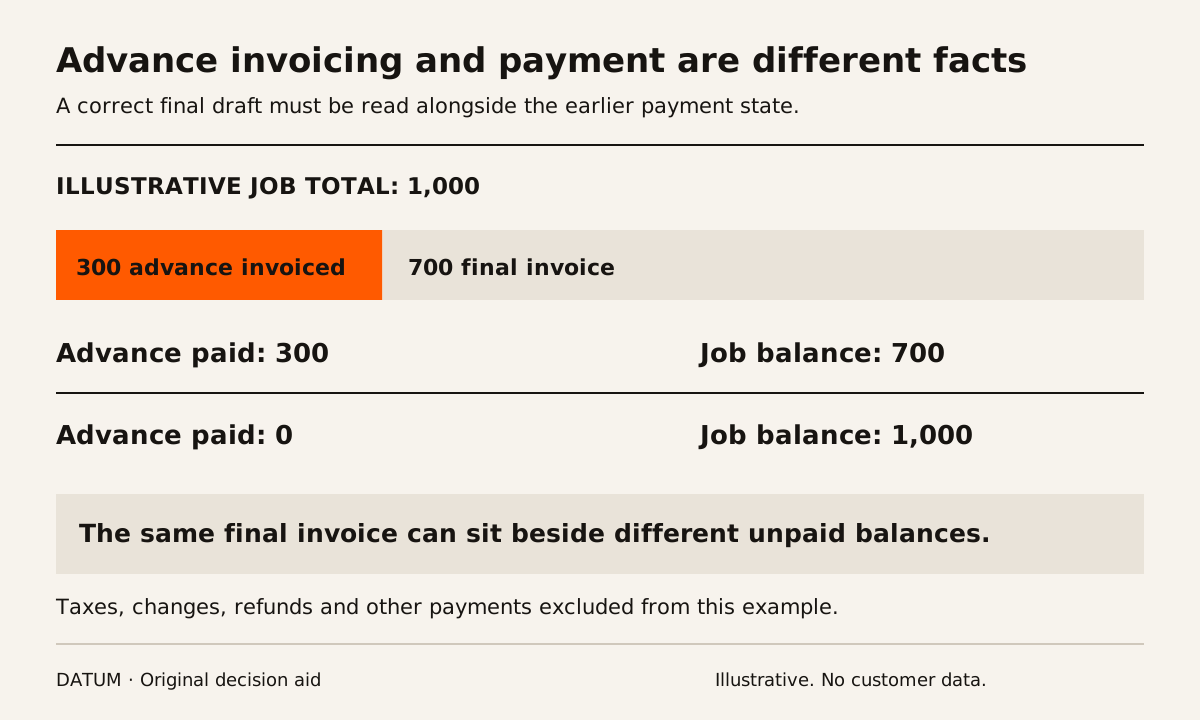
Reconcile a customer deposit through three separate facts: what was invoiced in advance, what was actually paid and what remains to be billed for the completed job. A deposit invoice is not evidence of received cash. Deducting an advance from a final invoice also does not prove the earlier invoice was paid.
Odoo 19 Sales documents fixed-amount and percentage down-payment invoices, created first as drafts. It distinguishes these from payment terms that split one invoice into installments. Use the workflow that matches the agreed commercial arrangement, with the accounting owner confirming the configuration and treatment. Odoo 19 down payments.
Put the whole job on one reconciliation sheet
The office should be able to trace the accepted job, approved changes, advance invoices, payment evidence and final draft using saved references. Keep a deposit on one job from becoming an unexplained credit against another simply because the customer is the same.
| Record | What the reviewer establishes |
|---|---|
| Accepted job and revisions | Current agreed commercial basis |
| Advance invoice | Amount, status, job link and issue reference |
| Payment evidence | Amount received and the invoice or account it settles |
| Completion evidence | Work supporting final billing |
| Final draft | Remaining billing after the applicable advance treatment |
| Customer balance | Amount still owed across all relevant posted records |
| Exception | Unpaid, overpaid, transferred, cancelled or disputed amount with an owner |
This is an operational review sheet, not a choice of revenue recognition, tax treatment or ledger account. Have the responsible finance professional determine those matters for the actual business and jurisdiction.
Compare two cases with the same final draft
Take a purely illustrative job with an agreed total of 1,000. An advance invoice requests 300, and the final billing calculation is 1,000 minus 300, leaving a 700 final invoice. Taxes, refunds, discounts and changes are excluded so the distinction is visible.
| Example state | Advance invoiced | Advance paid | Final invoice | Total customer balance after both invoices |
|---|---|---|---|---|
| Advance paid in full | 300 | 300 | 700 | 700 |
| Advance remains unpaid | 300 | 0 | 700 | 1,000 |
Both examples can show a 700 final invoice. Only one means the customer owes just 700 across the job. In the unpaid case, the balance is 300 plus 700, which equals 1,000. The examples assume no other payments or adjustments; verify the actual open records before communicating a balance.
Do not replace an unpaid advance invoice with a second full-job charge merely to make the final document look complete. Ask the accounting owner to resolve the documented state and approved correction path. Avoid issuing another invoice while the relationship between the existing documents remains unclear.
Rehearse the ordinary case and the awkward ones
In a test database, create the agreed job, advance draft and intended final draft under the proposed Odoo 19 configuration. Have the billing reviewer explain the order links and remaining amount without receiving a verbal history.
Odoo's documented example separately describes posting the advance invoice, recording payment and creating the later regular invoice. Payment state depends on configuration and confirmation. Inspect those states rather than treating the existence of the down-payment line as completion of every step. Odoo down-payment workflow.
Then test an unpaid advance, a partial payment and a job whose scope changes before final billing. Keep cancellation or refund cases with the finance owner; this guide does not prescribe their entries or imply that every amount can be deducted in every delivery state.
Use the approved-extra handoff to keep a later addition connected to its own acceptance and completion evidence. Otherwise, the final bill may combine an accurate deposit calculation with an unsupported extra.
Release the explanation before the bill
Ask a second office reviewer to reconstruct the example from the records. They should identify the current job total, the advance billed, the amount received and the remaining balance. Record any unexplained difference and assign its owner before the customer-facing step.
The draft-invoice review method supplies a line-by-line evidence check even when no AI is involved. Add the deposit reconciliation to that review so a mathematically correct final invoice cannot hide an unpaid earlier document.
Accept the workflow when the office can explain both the final invoice and the customer's total remaining obligation from the same traceable job record.