
Carry an approved extra from the quote to the crew and bill
Keep an approved extra traceable through scope, crew instructions, completion and billing. Test partial work, revisions and the office readback.
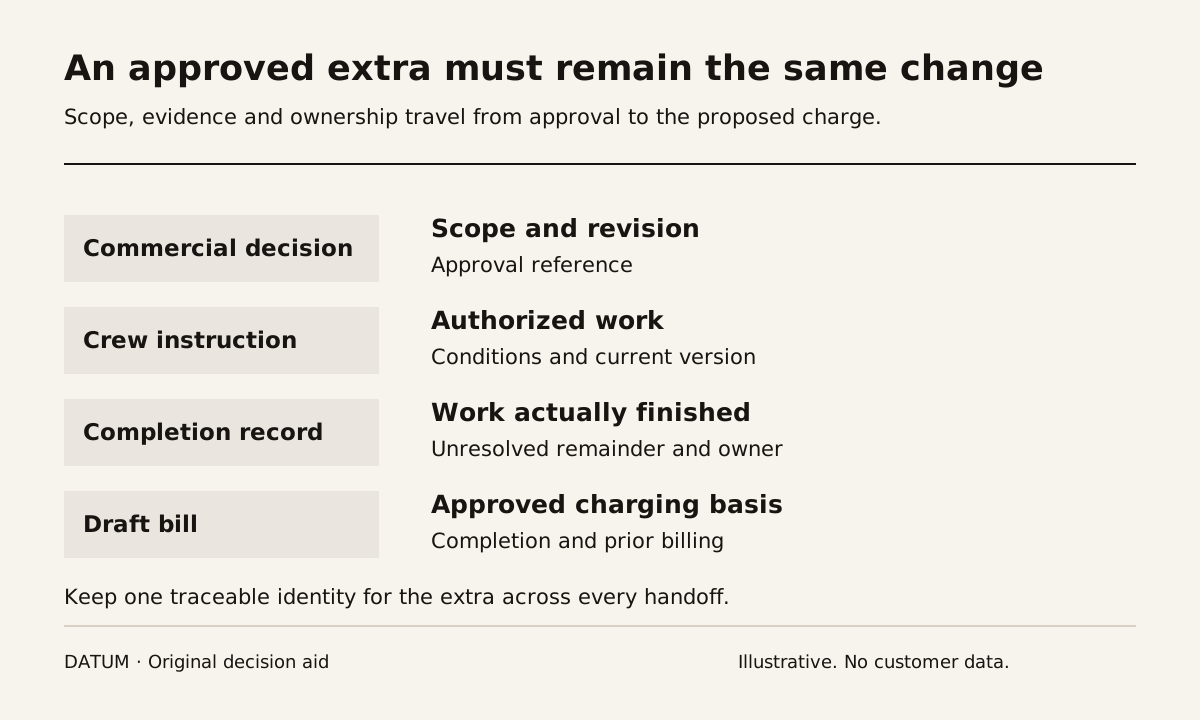
An approved extra needs to travel as a defined change, not as a fragment of a conversation. Carry its scope, approval reference, affected job, execution instruction and charging basis from the commercial decision to the crew and the billing reviewer.
The crew needs to know what to perform. The office needs to know what was authorized and completed. Keeping those questions connected prevents an approved addition from being lost, repeated or billed under the wrong job.
In Odoo 19 Sales, a confirmed quotation becomes a sales order. That documented commercial record can be part of the change trail, but it does not by itself prove that the field instruction or billing review includes the extra correctly. Odoo 19 quotations.
Give the extra a usable identity
Use a short reference linked to the original job. Record the exact additional work and what remains outside it. Include the source of approval and the person authorized to interpret any ambiguity.
Consider a fictional service visit where the customer approves replacing a second failed component after the original repair is inspected. “Customer said yes” does not identify which component, which work or which charging basis. The office should be able to retrieve the approved change without asking the technician to reconstruct the conversation.
This is an operational record design. It does not decide whether a particular approval is legally sufficient or replace the business's contracting process.
Build the change record once, then prove each handoff
| Part of the record | Who needs it | What it should answer |
|---|---|---|
| Original job reference | Everyone handling the change | Which accepted work is affected? |
| Extra scope and revision | Crew and service lead | What additional work is authorized? |
| Approval reference | Commercial and billing owners | Who approved which version? |
| Execution conditions | Dispatcher and crew | Are material, access and prerequisites ready? |
| Charging basis | Billing reviewer | How should the approved addition appear in the draft? |
| Completion evidence | Office and customer-facing reviewer | What was actually finished? |
| Unresolved remainder | Next-action owner | What still needs a decision or another visit? |
The extra may be represented through a revised order, a separate linked record or another approved method. The important requirement is that the people receiving the change can trace it to the same accepted scope. Do not prescribe the record design before checking the existing workflow and software.
The Field Service worksheet guide helps distinguish the technician's observations from the approval itself. A task note can report a problem without authorizing its repair.
Test the crew's understanding before testing the bill
Ask a technician who did not participate in the approval to open the assigned work. Have them identify the original scope, the extra and any conditions still unresolved. If they cannot distinguish the two, revise the instruction or record relationship before adding more automation.
Then have the dispatcher change the planned visit in the test environment. Check whether the extra remains associated with the correct job and whether the returning technician sees the current instruction. Moving a calendar entry should not require copying commercial approval into another private message.
These are acceptance conditions to demonstrate in the proposed configuration. They are not claims that a particular system propagates every change automatically.
Include partial completion and withdrawal
Run a case where the crew completes the original work but cannot finish the extra. The office should see what remains and who must act. A single completed-job label may be insufficient if it hides the unfinished addition.
Next, withdraw or revise the extra before work starts. Have the authorized owner record the new decision and inspect what the crew sees. Preserve the earlier context without leaving the superseded instruction as the apparent current task.
For fixed-price work, use the material-use billing test to keep included consumption distinct from approved additional scope. An extra and its materials should not accidentally become two separate charges for the same agreement.
Review the draft from the receiving office role
Have the billing reviewer prepare the draft using only the saved records. They should identify the approved addition, completion evidence and prior billing without an oral explanation. Use the completed-job billing guide for the wider review.
Keep a discrepancy log for omitted extras, duplicated lines, wrong job references and unclear completion. Correct the source or relationship that caused the problem, then rerun the same case.
The acceptance result is a continuous explanation from approval to work performed to proposed charge. When one link is missing, leave the question with a named owner before the next person acts on an incomplete record.