
Build an Odoo timeline around what must be ready
Map the decisions, data, people and tests that determine an Odoo implementation timeline. Use readiness evidence before committing to a release date.
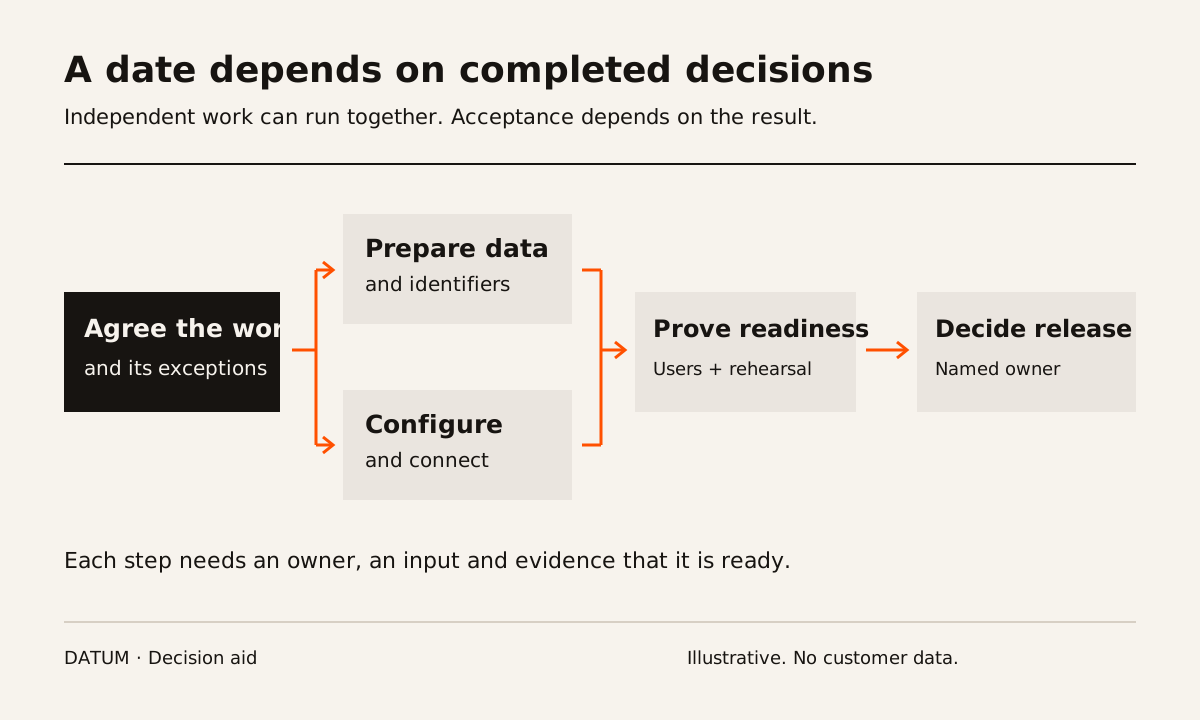
A useful Odoo implementation timeline shows what must be ready before the next step can finish. It names the people who can resolve those dependencies. A proposed go-live date without that information is a target, not a dependable delivery plan.
There is no duration promised in this guide. A first workflow with clean records and available decision makers has a different path from a project that includes several companies, uncertain interfaces and custom development. Ask a provider to estimate your defined scope and explain the assumptions behind the dates.
Read the plan from the first live task backward
Choose the first task the team must perform reliably in production. In a fictional plumbing business, that might be preparing an invoice from an approved job and completed field notes. Work backward from that task.
Billing needs to recognize a billable job. The field team needs a usable completion record. Both need a shared job identifier, agreed approval rules and appropriate access. Testing needs representative records. Training needs a stable version of the process. The calendar should reveal these relationships.
This does not mean every activity waits for the previous one. Product cleanup and role preparation can proceed together when their decisions are independent. But final validation cannot prove an integration whose mapping is still changing.
Use this dependency sheet to replace vague labels such as “configuration, week three.”
| Work that must finish | Ready when | Dependency owner | What blocks the next step |
|---|---|---|---|
| Define the first workflow | Normal path, exceptions and acceptance examples are agreed | Business process owner | Different teams expect different results |
| Prepare migration inputs | Required records, identifiers and exclusions are checked | Data owner | Missing exports or unresolved duplicate records |
| Configure the workflow | A representative record completes the agreed path | Delivery lead | Open business rules or an unproven product gap |
| Connect other systems | Mapping and failure handling work in a test setting | Integration owner | Missing access or unavailable interfaces |
| Run user acceptance | Actual roles pass the agreed scenarios | Named business reviewers | Defects, unclear expected results or absent reviewers |
| Rehearse cutover | The team can perform and validate the changeover | Cutover owner | Unreconciled data or untested recovery steps |
| Start live work | Readiness decision is recorded and support is reachable | Authorized business owner | An unresolved release-blocking condition |
Keep the last column concrete. “Data risk” cannot be assigned. “Three product units have no agreed conversion” can.
Put human availability on the calendar
Ask each decision owner when they can actually review work. A consultant's availability does not make the controller available during close or a service manager available during the busiest dispatch period.
Record the task, required person, expected preparation and next available review window. If the plan assumes a same-day decision, confirm it. If nobody can make that commitment, the date must reflect the delay or the scope must change.
For the fictional plumbing business, suppose the field-completion screen is configured but the supervisor can only review it after a scheduled shutdown. The dependency is the supervisor's acceptance, not another configuration sprint. Assigning more developers does not resolve it.
Keep a short decision log with the proposed rule, alternatives, owner and consequence of waiting. A design can be provisional while independent work continues. It should not silently become the basis for migration or training.
Rehearsal needs its own time and evidence
An import finishing is different from a migration being accepted. Odoo documents that imports are permanent and cannot simply be undone. That makes a representative rehearsal and a specific recovery decision part of planning, rather than spare work to squeeze in before launch. Odoo 19 import documentation.
Plan time to inspect rejected rows, reconcile counts and totals, correct mapping and rerun affected cases. The amount depends on what the rehearsal discovers. A clean sample does not establish that every source file is clean.
The test environment also matters. Odoo.sh staging branches use neutralized copies of production data and change the behavior of external actions such as outgoing email. Confirm what your rehearsal is actually testing and what needs a separate controlled check before release. Odoo 19 Odoo.sh staging documentation.
A demonstration in staging therefore cannot, by itself, prove that a production message reached its recipient or that a live external connection is configured.
Decide what changes when a date moves
When a dependency slips, ask for a revised path, not a new date pasted over the old one. There are several possible responses, each with a tradeoff:
- Remove a nonessential item from the first release and name its later destination.
- Complete a missing decision or data correction earlier, if the responsible person can do it properly.
- Add qualified help to work that can run in parallel.
- Move the release window to preserve required testing and operational coverage.
Do not recover the schedule by quietly deleting the acceptance test that makes the release safe to use. If a test is unnecessary, explain why the underlying risk no longer applies.
Before accepting a timeline, select one critical path through the sheet and ask the delivery team to walk it with you. Each step should end with a named output, a reviewer and evidence of completion. Use the handoff worksheet to define that first workflow before assigning dates to it.