
Test an AI receptionist before it answers for your business
Rehearse contractor calls, corrected addresses, failed transfers and booking requests. Check the office handoff before expanding an AI receptionist pilot.
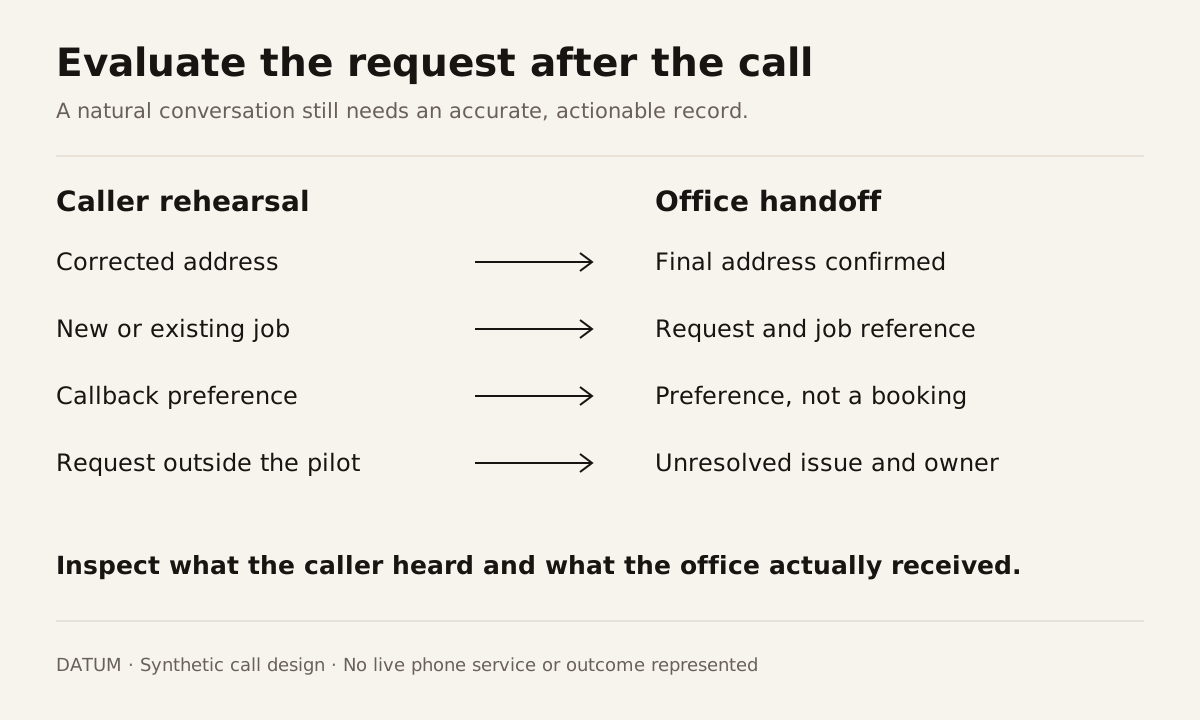
Start an AI receptionist pilot with a narrow job: collect a service request and hand it to the right person. Test that handoff before allowing the system to promise availability, quote work or change an existing appointment.
For a contractor, the useful result is a request the office can act on. A conversation that sounds natural can still leave out the service address, confuse a callback number or promise a visit that nobody scheduled. Evaluate the record and the commitment the caller heard.
The pilot below is a proposed operating method. It is not a tested DATUM phone service or a claim about a particular voice vendor. NIST's voluntary AI framework supports defining a system's context, responsibilities and evaluation before relying on it. It does not prescribe this call script or certify the result. NIST AI RMF Core.
Limit the first version to one kind of request
Choose a service your team already knows how to qualify. Write down the locations served, the information the office needs, business hours and the handoff destination. Provide approved answers for the few questions the system may answer.
Keep the boundary specific. For example, a fictional HVAC business might allow the receptionist to collect a maintenance request and preferred callback time. It might require a person to confirm appointments, interpret unusual equipment issues or discuss work outside the normal service area.
Avoid giving the system a general instruction to “close every lead.” A better instruction describes the record to prepare and where the conversation must stop. If the calendar connection fails, the system should preserve the request without saying that a visit is confirmed.
Inspect the request the office will receive
Use a handoff record like this in the rehearsal:
| Field | What the record should contain |
|---|---|
| Caller and callback | Confirmed name and callback details |
| Service address | Address repeated back for correction |
| Request | The caller's description, with uncertainty preserved |
| Existing work | Whether this concerns an existing job or a new request |
| Preferred contact time | A preference, clearly separate from a booking |
| Commitment made | Exactly what the receptionist promised |
| Destination | Named queue or responsible role |
| Unresolved issue | What a person still needs to check |
Collect only information needed for the task. Decide where recordings, transcripts and summaries may be retained before connecting real calls. Your company's communications and data requirements must be resolved for the locations and service involved; the worksheet does not establish those requirements.
Rehearse the awkward calls before the straightforward ones
Have staff play callers using synthetic names, addresses and job numbers. Change one condition at a time so a failure is easy to understand.
| Rehearsal | What the caller does | What a useful response demonstrates |
|---|---|---|
| New service request | Gives ordinary details | The office receives an accurate request |
| Corrected address | Changes the street number halfway through | The final record preserves the corrected address |
| Existing customer | Asks to change a current appointment | No change occurs without the agreed identity and approval process |
| Unclear request | Uses a vague description or background noise | The system asks a limited clarifying question or transfers |
| Price pressure | Insists on an immediate quote | The system stays within approved price information |
| Calendar unavailable | Asks for a confirmed appointment | A preference is not described as a booking |
| Urgent concern | Describes a situation outside the pilot | The agreed escalation route is used without improvised technical advice |
| Repeated call | Calls again about the same request | The office can identify the possible duplicate |
For urgent situations, use an escalation script reviewed by the people responsible for your service. The pilot should not invent diagnosis or safety instructions. Test whether the expected transfer route is available and what happens when nobody answers.
Let the caller correct the summary
A short confirmation can reveal an error while the caller is still present. In the fictional maintenance pilot, the closing might be:
“I have a maintenance request for the address you confirmed, and you prefer a callback tomorrow morning. I’m sending that request to the office. An appointment has not been booked. Is that correct?”
That is sample wording, not a universal script. Adapt it to the actual action the system took. If the request has not yet reached the office, do not say it has. Keep system failures visible to the person supervising the pilot.
Review both the conversation and the resulting record. Check for an accurate address, correct callback details, preserved corrections and a truthful description of the next step. Count unsupported promises separately from minor wording problems. One metric should not hide their different consequences.
Test the people receiving the calls too
Send the synthetic handoff through the intended route and ask the office to process it. Can they tell who should respond? Does the record contain enough information? Can they see that a customer was promised a callback but no appointment?
Measure the time needed to review and repair the request. Keep abandoned transfers, lost messages and duplicate records in the results. A pilot that reduces answering time but creates a longer office cleanup has not established a useful saving.
Set the expansion decision before running live traffic. State which errors stop the pilot, who watches the queue and how calls return to the existing process. Review the first permitted calls with the responsible person and expand only the behavior that has evidence behind it.
If the first task is still too broad to describe, use the guide to choosing an agent task to narrow the result and its reviewer.