
Trace component use before releasing a manufacturing change
Map direct and indirect component use before releasing a revision. Check variants, search coverage and open-work decisions with an impact-review sheet.
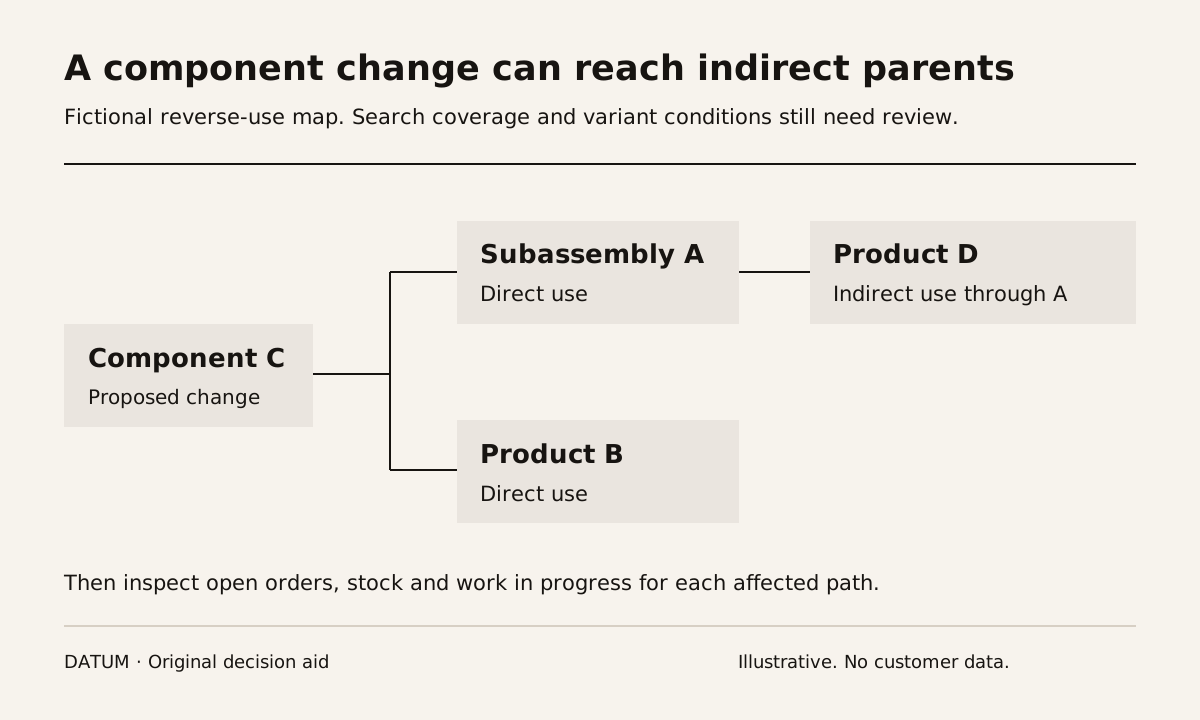
Before releasing a component change, identify its direct parents, follow those parents into higher assemblies and review the open work that uses the affected definitions. A list of bills of materials containing the component is a starting point. It does not, by itself, explain the effect on subassemblies, purchased stock or work already in progress.
In Odoo 19, engineering change orders can manage revisions to products and bills of materials. The documentation describes a separate revised bill of materials whose changes do not affect the production version until applied. That revision mechanism does not remove the need to establish the scope of the impact review. Odoo 19 engineering change orders.
Define what your search must cover
Record the component's exact identity, including any relevant variant or revision. Then define which companies, product families, active definitions and planned revisions the review includes. Have the data owner confirm that the person running the search can see those records.
Search results can look complete while a filter excludes a second company or an alternate bill of materials. Preserve the filter and the extraction date with the result. If the search method cannot cover an important category, label that category unresolved and assign a separate review.
Do not claim that a button or report finds every affected assembly until its coverage has been tested against known examples in the intended version and configuration.
Build a reverse-use map
Use a fictional component C that appears in subassembly A and finished product B. Subassembly A also appears in finished product D. The direct parents of C are A and B. D is affected indirectly through A.
Start with the component and work upward. For each parent found, check whether that parent is itself used in another assembly. Continue until the agreed product scope has no unexplored parent relationships. Track already reviewed records so a duplicate relationship does not become a second, misleading impact item.
| Impact record | What to retain |
|---|---|
| Component identity | Code, relevant variant and proposed change |
| Direct parent | Bill of materials, version and component quantity |
| Indirect parent | Path through the affected subassembly |
| Commercial or technical condition | Variant, option, company or alternate definition |
| Open work | Relevant orders or work in progress needing a decision |
| Disposition | Continue unchanged, change, hold or investigate |
| Approval | Responsible person and effective boundary |
This is an original review method. It is not a claim that Odoo's default interface automatically builds the full map or updates every open order.
Distinguish definition impact from operational impact
An assembly definition may need a revision while an existing order should continue under its accepted version. Another order may need to stop because the changed component is no longer permitted. Engineering, operations and the commercial owner must establish that boundary.
Ask what happens to component stock, open purchases, released work, unfinished assemblies and completed goods. Avoid changing all of them simply because they share a code. The appropriate disposition depends on the reason for the change and the decisions of the responsible people.
Use the manufacturing production-model card to identify where order-specific approval differs from a shared product definition. The planning input ledger helps identify the scheduled work that relies on the affected materials or instructions.
Test the map with known inclusions and exclusions
Before trusting the extraction, create or identify a permitted test set containing a direct use, an indirect use, a variant-specific use and a similar-looking component that should be excluded. Confirm that the results include the intended paths and preserve the distinction between variants.
Odoo documents component assignment by product variant within a shared bill of materials. That makes variant conditions relevant to the review rather than a detail to discard when exporting the parent list. Odoo 19 variant bills of materials.
If a known affected assembly is missing, investigate the search method before using the result to authorize a release. Fix the scope or extraction and rerun the test, retaining both the issue and the corrected evidence.
The completed impact review should identify the checked record population, every discovered path, unresolved coverage and the approved treatment of open work. That is a defensible basis for releasing a revision. An unqualified “where-used search complete” is not enough when nobody can explain what the search included.