
Which component revision went into the finished product?
Trace a finished lot or serial back to actual component consumption and revision evidence. Includes an as-built worksheet and a substitution test.
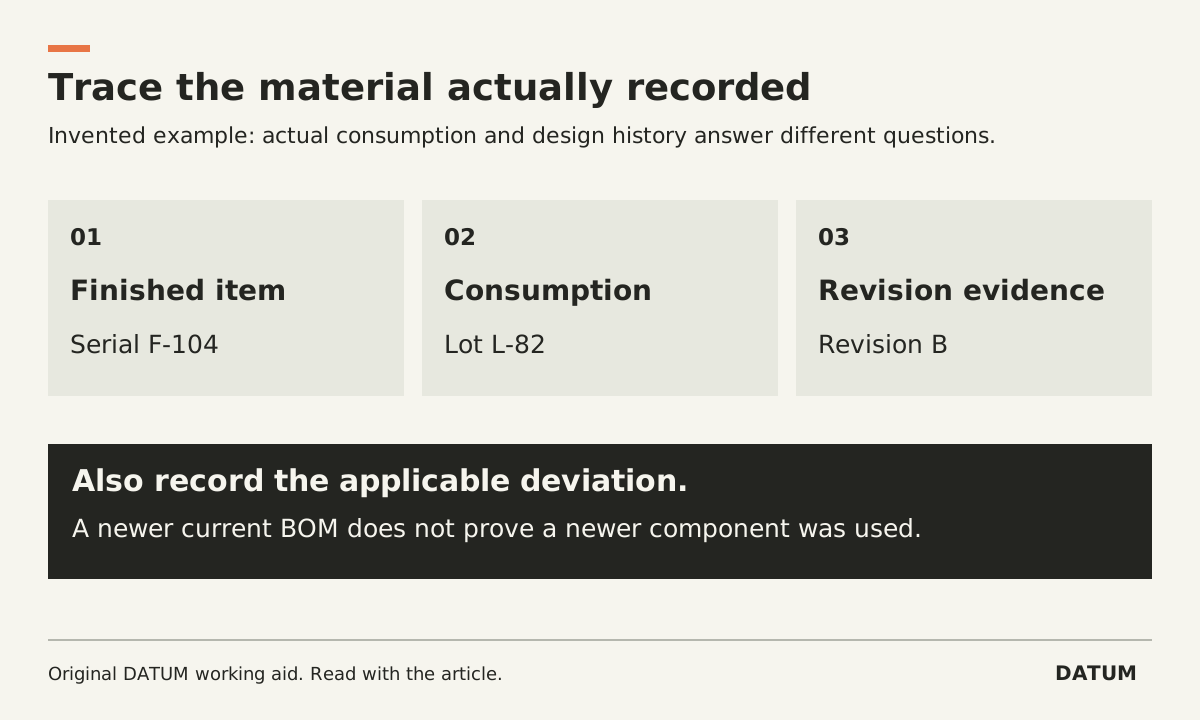
To prove which component revision went into a finished product, connect the completed production record to the component actually consumed, then connect that component to its revision evidence. The current bill of materials answers a different question: what production is supposed to use now.
A date can narrow the investigation. It cannot settle it when old stock, substitutions or work already in progress crossed the change date. Build the record around the finished lot or serial number that the customer has.
Keep the design history and the build history together
Odoo 19.0 PLM keeps previous BOM versions, components, operations and design files through engineering change orders. The revision history can show the person who applied a change and its effective date. The documentation also notes that an empty Effective Date can leave that date absent from the revision history. Check the actual history rather than assuming every revision has a clean date boundary. Odoo 19.0 version control.
Lot tracking serves another purpose. Odoo describes lots as batches that can be followed through receipts, storage, manufacture and delivery. Lot records can carry additional information, and their traceability report follows stock operations. Those records help establish which material moved. A lot number does not, by itself, establish an engineering revision. Someone must maintain the relationship between the lot and the controlled revision evidence. Odoo 19.0 lot numbers.
For an investigation, ask for both histories. If they disagree, preserve the disagreement and have quality or engineering resolve it.
Work backward from one delivered unit
Use this worksheet with a completed order. These are proposed review fields, not a claim that one standard Odoo screen supplies all of them.
| Evidence to collect | Question it must answer | If it is missing |
|---|---|---|
| Finished product and lot or serial | Which delivered items are in scope? | Identify the affected population before drawing a conclusion |
| Manufacturing order and completion record | Which build produced those items? | Find the production reference, not just the customer order |
| Actual component consumption and lot | Which material was recorded as used? | Treat the revision as unproven |
| Component lot's revision evidence | Which drawing or specification applies to that material? | Check receiving evidence and controlled records |
| BOM/ECO history used for the build | What was the intended configuration? | Recover the historical record; do not substitute today's BOM |
| Substitution or deviation authorization | Was a difference permitted for this build? | Escalate the difference to the responsible owner |
Record links or identifiers in the worksheet. “Engineering confirmed it” is weaker than a reference another person can open.
Consider an invented example. Finished serial F-104 was completed after revision C became current. Its production record shows consumption from component lot L-82. Receiving evidence identifies L-82 as revision B, and an approved deviation names F-104. The defensible finding is “revision B was recorded as used under this deviation.” Calling it revision C because of the completion date would erase the exception.
If L-82 contains mixed revisions, the lot is too broad to answer the question. Do not choose the more likely revision. Mark the result unresolved and decide what additional inspection or records the quality owner needs.
Test the connection before you need a recall answer
In a test environment, prepare two distinguishable component revisions and a finished tracked product. Run a normal build, an authorized substitution and a build spanning a revision change. Have someone who did not enter the records trace each finished item backward and explain the result.
The acceptance criterion is practical: the reviewer can identify the recorded component revision, the evidence supporting it and any permitted deviation without relying on the operator's memory. Also test an incomplete record. The process should expose the gap, not manufacture an answer.
Use the engineering change release guide to decide how the new design becomes effective. Use this worksheet afterward to determine what a particular build actually records.