
Manufacturing cost per unit needs a visible denominator
Calculate an illustrative manufacturing cost per accepted unit. Keep material, labor, station time, unfinished work and output definitions visible.
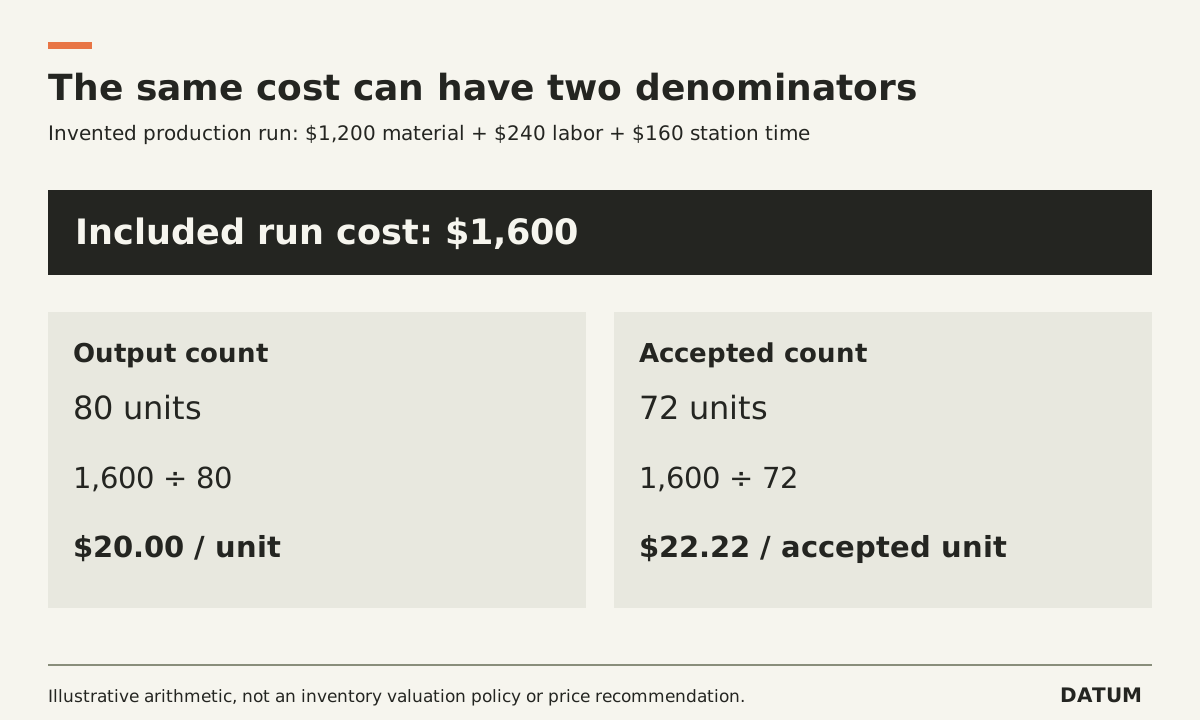
Calculate manufacturing cost per unit by stating which costs you include and which output count you divide by. Keep the calculation tied to one production scope and period. A number without those boundaries can look precise while describing something different from the decision you are making.
The example here is an operational worksheet, not an inventory-valuation policy or a selling-price recommendation. Your finance owner should determine the treatment of overhead, scrap, work in progress and accounting entries for your business.
Build the numerator from visible records
Consider an invented production run with $1,200 of material, eight labor hours at an illustrative $30 per hour, and eight station hours at an illustrative $20 per hour. For this example, the station rate excludes the labor already shown separately.
The included run cost is $1,200 + (8 × $30) + (8 × $20) = $1,600.
At 80 accepted units, the included cost per accepted unit is $1,600 ÷ 80 = $20. These are invented inputs, not industry benchmarks, wage guidance or customer results.
| Cost input | Illustrative calculation | What must be clear |
|---|---|---|
| Material consumed | $1,200 | Which issued, returned and scrapped quantities are included? |
| Direct labor | 8 hours × $30 = $240 | Is the rate defined consistently with the purpose of the report? |
| Station time | 8 hours × $20 = $160 | Does this rate already include any labor or overhead above? |
| Included run cost | $1,600 | Which relevant costs remain outside this example? |
| Accepted output | 80 units | What inspection and completion state establishes acceptance? |
| Included cost per accepted unit | $20 | Does the denominator match the numerator's run and scope? |
A supplier purchase is not automatically material consumed by this run. A shift total is not automatically labor used on this order. Preserve the link between each input and the order or agreed allocation rule.
Make the denominator visible
Suppose the same run cost produces 80 units, but only 72 have been accepted. Dividing by 80 gives $20; dividing by 72 gives about $22.22 per accepted unit. Neither number should be presented without its label.
The eight remaining units may require rework, may be awaiting inspection or may be scrapped. Those states have different operational meanings. Do not silently turn every non-accepted unit into scrap, or treat a temporary inspection queue as a final yield result.
If rework is still underway, the cost may also be incomplete. Show the report date and unfinished work so the reader knows whether the number is a current observation or a closed-run result.
For a mixed-product run, do not divide all cost by an undifferentiated count unless that unit basis makes sense. Identify the allocation method and have the responsible finance and operations owners agree how the comparison will be used.
Compare expected and observed cost without mixing them
Odoo 19.0 distinguishes the expected manufacturing-order cost based on the bill of materials from the real cost associated with actual production. Differences can arise from quantities, time or component prices. See the versioned manufacturing-order cost documentation.
Use that distinction when designing a report. Keep the estimate available, state which values are actual and identify values still supplied by a standard or estimate. Do not describe a partially recorded order as final actual cost merely because the system displays a total.
A useful investigation asks which input moved. Did material consumption change? Did the operation take longer? Was accepted output lower? The bill-of-materials worksheet helps make the original quantities and units explicit.
Use the result for one decision
Choose a completed, traceable run before using the worksheet across a product family. Ask operations to confirm the physical quantities and finance to confirm the cost definitions. Resolve unexplained differences before comparing two periods or machines.
For the next run, preserve the same definitions. Otherwise, a change in reported unit cost may reflect a new denominator or allocation rather than a change in work. The capacity worksheet can support the separate scheduling decision; unit cost alone does not establish that an order fits the available time.