
Manufacturing capacity starts with the hours you can use
Estimate manufacturing capacity with visible shift, setup, maintenance and rate assumptions. Use a worked example before making the next delivery promise.
Estimate capacity at the resource that limits the order, using the time that resource can actually work and the time each acceptable unit requires. Keep shutdowns, setup, competing work and uncertainty visible. A weekly shift total is only the starting number.
This worksheet is a planning aid, not a production promise. The rates below are invented to show the calculation. Replace them with observations from the specific product, machine, crew and operating conditions you plan to use.
Start with one resource and one product
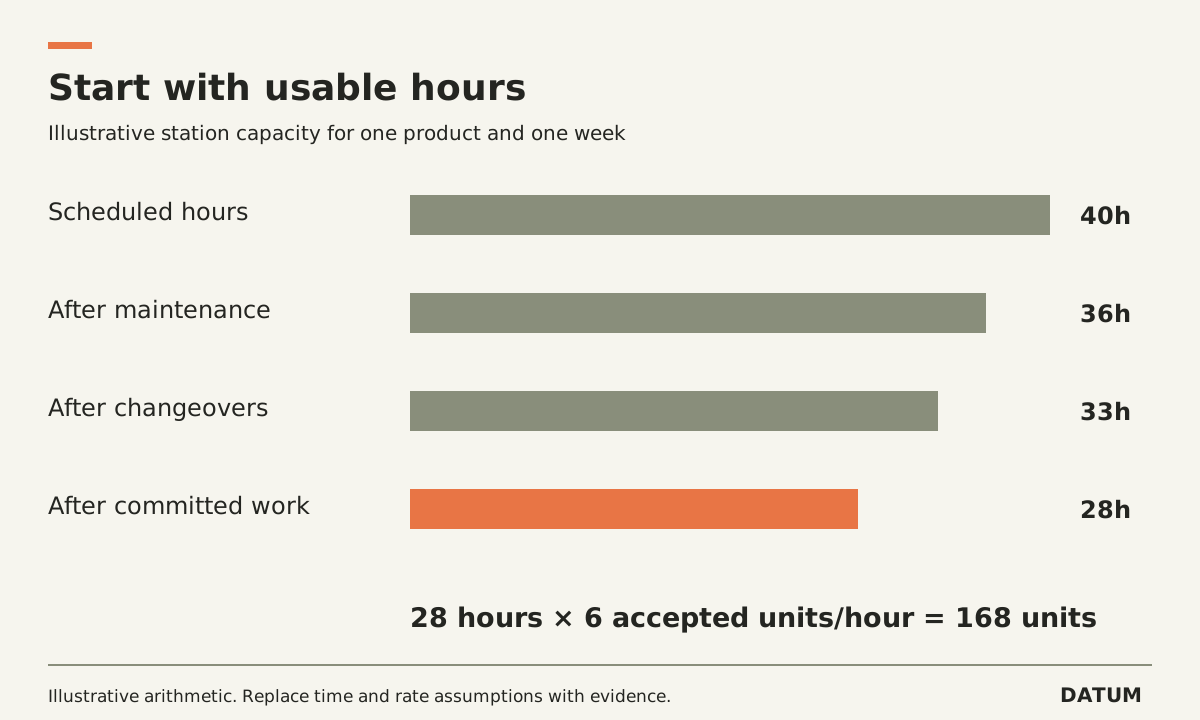
Suppose a fictional fabrication shop needs to estimate next week's capacity at a finishing station. The station has 40 scheduled hours. Planned maintenance takes four hours, changeovers take three and other committed orders require five. That leaves 28 hours for the product being considered.
At an observed rate of six acceptable units per hour, the planning estimate is 168 units: (40 − 4 − 3 − 5) × 6 = 168.
The phrase acceptable units matters. If the observed rate already counts only accepted output and includes ordinary interruptions, do not apply another generic loss percentage for those same events. If you use an ideal cycle rate instead, label it and account separately for the losses you expect. Mixing the two methods can count the same loss twice.
| Input | Illustrative value | Evidence to replace it |
|---|---|---|
| Scheduled station time | 40 hours | Actual shift calendar |
| Planned maintenance | 4 hours | Approved maintenance window |
| Changeovers | 3 hours | Sequence and observed setup time |
| Other committed work | 5 hours | Released orders using this station |
| Time available to this product | 28 hours | Difference of the rows above |
| Accepted output rate | 6 units/hour | Comparable completed runs |
| Planning estimate | 168 units | Available time × accepted rate |
Keep employee time and machine time separate when they are different constraints. A machine that can run unattended for part of a cycle should not automatically consume a full operator-hour for every machine-hour. Conversely, two machines do not double output if the same operator must attend both continuously.
Ask what makes the estimate move
Use a small sensitivity range instead of reporting 168 as certainty. At five accepted units per hour, the same 28 hours supports 140 units. At seven, it supports 196. These are alternative assumptions, not confidence intervals or promises.
Now test the consequence. If the customer needs 180 units, the middle estimate is short by 12. The decision is to investigate another feasible shift, route, sequence or date. Changing the spreadsheet's rate to make the promise fit does not create capacity.
Check upstream and downstream resources too. Finishing capacity is irrelevant if the parts cannot reach that station or inspection cannot release them. Record the lowest feasible output across the required route, with the conditions that could move the constraint.
Put the assumptions into the planning system
Odoo 19.0 documents work-center working hours, time efficiency, setup and cleanup, and product-specific capacity settings. Those settings describe different inputs; a capacity value is not a complete weekly output forecast. Review the versioned work-center documentation while checking the configuration used in your environment.
Do one rehearsal with a known completed order. Enter the historical calendar, sequence and quantities, then compare the plan with what happened. Investigate a mismatch before using that configuration to make a customer commitment. The five-job ERP demonstration can include this order as a capacity case.
Keep a short assumption log beside the estimate: who supplied the rate, which runs support it, what is excluded and when it expires. Update it after a material change in product, equipment or staffing. Do not quietly replace an estimate with actuals; keep both so the next plan can learn from the difference.
Before accepting the next order, ask the planner to show the available hours, rate evidence and constrained resource. If one is missing, the number is a proposal awaiting evidence.