
Reserve your team’s time before setting the ERP date
Build an ERP capacity calendar around decisions, data checks and role testing. Show uncovered work by person and week before committing to a date.
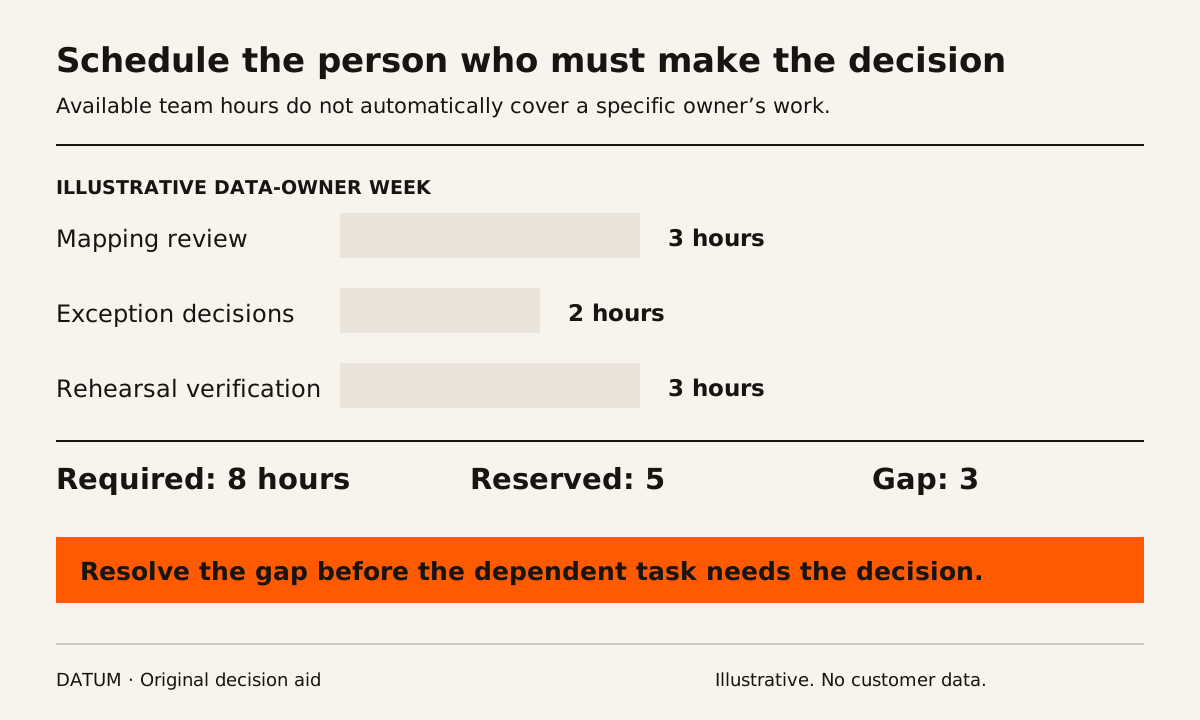
Reserve the business team's decision, data and testing time before accepting an ERP delivery date. Supplier availability does not create capacity inside the company. A plan can be fully staffed by consultants and still wait on a warehouse owner who has no time to verify the product list.
Ask each work owner for available hours in the actual weeks when the work is needed. Compare those hours with a named set of deliverables, including review and correction. A total headcount or an informal promise to “help when needed” is too vague to schedule.
Start with deliverables that consume internal time
List the work that depends on business judgment: confirming a process rule, resolving customer identities, checking unit conversions, reviewing imported records, performing user tests and preparing role instructions. Distinguish work the supplier can prepare from decisions only an authorized business owner can make.
Odoo 19's import documentation describes testing an import before loading and using identifiers to preserve relationships. Those technical steps still need someone who can judge whether the resulting business records are correct. Odoo 19 import documentation.
Use the migration rehearsal guide to turn “help with data” into a specific review assignment. Name the sample, expected relationships, exception owner and evidence to return.
Put available and required hours beside each other
Use one row per person and week. Do not count the same hour as available to two projects. Include known operating responsibilities and absence before agreeing on project capacity.
| Person and week | Required project work | Hours required | Hours reserved | Uncovered work |
|---|---|---|---|---|
| Process owner | Decisions and acceptance review | Estimate by task | Confirmed calendar time | Difference and consequence |
| Data owner | Cleanup review and rehearsal exceptions | Estimate by task | Confirmed calendar time | Difference and consequence |
| Role tester | Normal and exception scenarios | Estimate by task | Confirmed calendar time | Difference and consequence |
| Training owner | Instructions and practice session | Estimate by task | Confirmed calendar time | Difference and consequence |
Treat the required hours as planning estimates, with an owner and basis. Revise them when a rehearsal reveals more exceptions; do not preserve an optimistic number merely because it appeared in the original schedule.
A short example exposes the bottleneck
Suppose, purely for illustration, that one data owner needs three hours to review mappings, two hours to resolve known exceptions and three hours to verify a rehearsal. The week's requirement is 3 + 2 + 3 = 8 hours. Only five hours are reserved, leaving three hours uncovered.
A second person has four free hours but cannot approve the product identities. Adding their hours to a team total does not resolve the first person's decision bottleneck. They may be able to prepare evidence or perform an assigned check, reducing the owner's workload, but that reassignment must be explicit.
The numerical example is not a staffing benchmark. Its purpose is to reveal whether the person with the required authority has time at the dependency point.
Resolve a gap before compressing the test
For an uncovered task, choose a concrete response: reduce the release scope, move the dependent date, reserve more time, prepare better inputs or assign qualified help. Keep the authority for the final decision clear even when preparation is delegated.
Avoid making the schedule appear feasible by deleting exception tests that expose the release risk. The user-acceptance case guide helps keep the essential scenarios visible. If a test is deferred, identify the resulting limit on what may go live.
Place a short decision deadline before the affected work begins. If the needed owner cannot confirm time, the sponsor should see the resulting date or scope choice while there is still room to change it.
Use the calendar as operating evidence
At each planning review, compare reserved time, completed deliverables and unresolved decisions. Hours consumed without an accepted result are not the same as completion. Record why a task remains open and whether the next week can absorb it.
Keep a substitute for absence where appropriate, with access, context and delegated authority established in advance. An available colleague who cannot see the records or make the decision is not yet a workable backup.
Agree to the delivery date when the required business contributions fit the actual calendar and the team understands the remaining uncertainty. That gives the supplier and company a schedule grounded in the work people can perform.