
Choose an Odoo partner using evidence from your own workflow
Evaluate an Odoo implementation partner with the same business scenario, evidence states and scope questions. Check the team that would deliver the work.
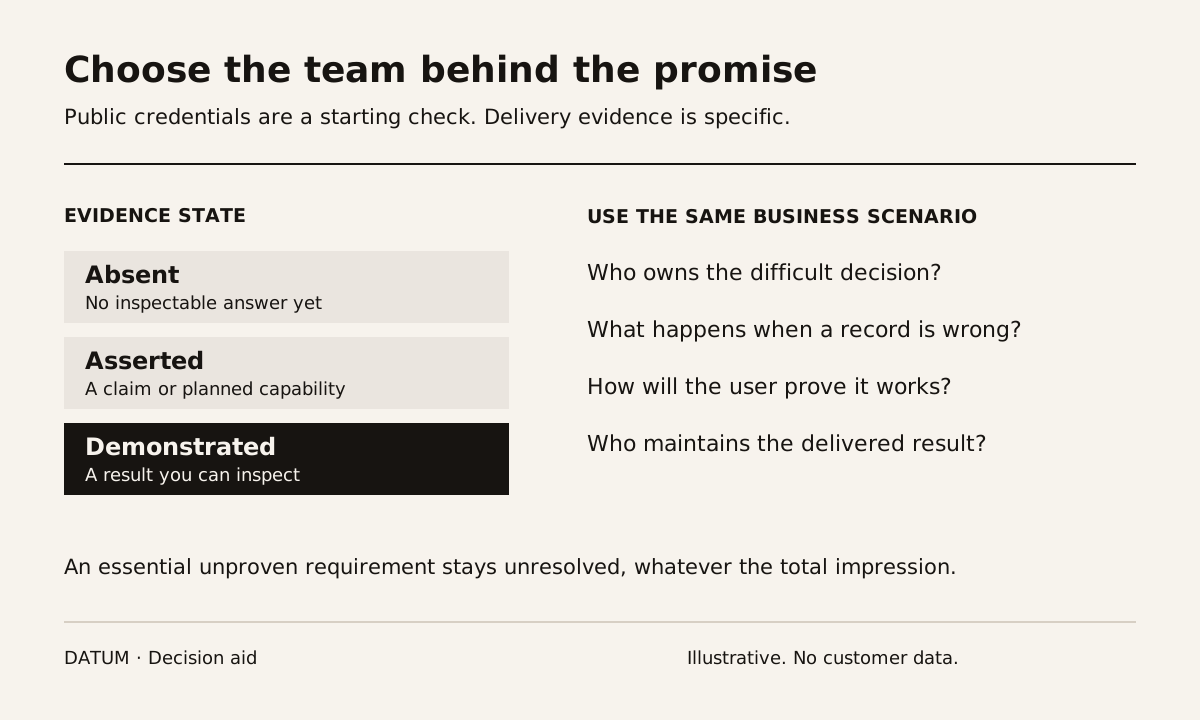
Choose an Odoo implementation partner by watching the proposed delivery team work through one of your business decisions. Verify its public claims, inspect relevant references and compare written scopes. A polished generic demo is only one piece of evidence.
Odoo maintains a partner directory that can help you check a provider's listed status, location and published profile information. Use the current listing for identity verification. It does not tell you who will be assigned to your project or prove that your workflow will work. Odoo's partner directory.
The following selection exercise is an original buyer's method. It does not rank providers, endorse a firm or imply that DATUM holds an Odoo partnership or certification.
Give candidates the same problem
Prepare a short scenario from your operation. Remove confidential data or use a clearly labeled fictional version. Include the current records, the problem to solve and one exception that your team handles today.
For example, a fictional metal shop accepts an order, discovers a material substitution is needed and receives the customer's approval. Purchasing needs the new material detail. Production must avoid working from the old revision. Billing needs to recognize any approved commercial change.
Ask candidates to explain:
- Which record owns the accepted requirement and its revision?
- Who is allowed to approve the substitution?
- What changes downstream, and what should remain unchanged?
- What happens if the customer has not approved it?
- How would the business verify the result before using it live?
Do not require a candidate to build a free custom application. The exercise can start as a walkthrough of the proposed approach. If a capability is critical and unproven, agree on a bounded validation step before treating it as included.
Score the evidence you can inspect
Use three evidence states rather than a precise-looking numerical score: absent, asserted or demonstrated. “Demonstrated” means there is an artifact or test result you can inspect, not that a salesperson repeated the claim confidently.
| Selection question | Useful evidence | Record your finding |
|---|---|---|
| Does the team understand our work? | It identifies the decision owner and an exception without hiding them behind app names | Absent / asserted / demonstrated |
| Is the proposed behavior available? | Exact edition, version and hosting are named; configuration and custom work are separated | Absent / asserted / demonstrated |
| Can it migrate our records safely? | Sample mapping, stable identifiers, reconciliation plan and rejected-row handling | Absent / asserted / demonstrated |
| Can our people operate the result? | Role-based acceptance examples and a training plan tied to real tasks | Absent / asserted / demonstrated |
| Will we be able to maintain it? | Named ownership for code, access, documentation and recurring support | Absent / asserted / demonstrated |
| Can it deliver the stated scope? | Proposed people, actual availability, dependencies and relevant reference conversations | Absent / asserted / demonstrated |
Before reviewing proposals, mark the items that are essential for your first release. An attractive result elsewhere should not cancel an unproven requirement that would stop the business from operating.
Write the evidence beside the state: a document name, demonstration date, version or reference note. This keeps the comparison useful when a candidate updates its proposal.
Meet the people who will make the difficult decisions
Ask who will lead process decisions, configuration, migration and user acceptance. One person may cover several roles, but the responsibility should be explicit. Find out which named people are committed and which are examples of the provider's broader team.
During the scenario, notice what happens when the candidate lacks an answer. A useful response identifies what must be checked, who will check it and how the answer affects scope. An immediate promise is not a substitute for that work.
Ask for a relevant customer reference with permission. Relevant can mean a similar workflow, data difficulty or deployment choice, not just the same industry label. Ask the reference what changed between the initial scope and release, how unresolved issues were handled and whether employees could complete their tasks afterward. Treat one reference as one account, not a measured success rate.
Resolve the deployment and support boundaries
Have the candidate identify the exact Odoo 19 Enterprise deployment it proposes. Odoo Online does not allow custom Python server code, while Odoo 19 documents importable XML/data modules as a separate approach. Ask the candidate to classify each proposed extension and confirm its deployment conditions. Odoo.sh provides a platform for hosting and managing Odoo applications. Odoo 19 importable modules, Odoo.sh.
Ask who will own the hosting account, repository and administrative access, and how authorized people can retrieve the documentation and data. Verify the arrangement in the proposed scope. Do not infer ownership from the person who presents the demo.
Support also needs a concrete definition. Who receives an issue? Who distinguishes a defect from a new request? What coverage is included? Which third-party services need separate support? Odoo's plan information distinguishes implementation services and custom-code maintenance from its software subscription, so check both the vendor plan and the partner's agreement. Odoo pricing.
Finish the selection exercise by asking each finalist to rewrite its proposal around the same scenario, acceptance evidence and exclusions. If one essential item remains asserted, make its validation the next decision. You can use the job-tracing guide to prepare a scenario that starts with records your team recognizes.