
What ERP discovery should leave behind
Define an ERP discovery handoff with process decisions, fit evidence, data ownership and acceptance cases. Keep unresolved assumptions visible in scope.
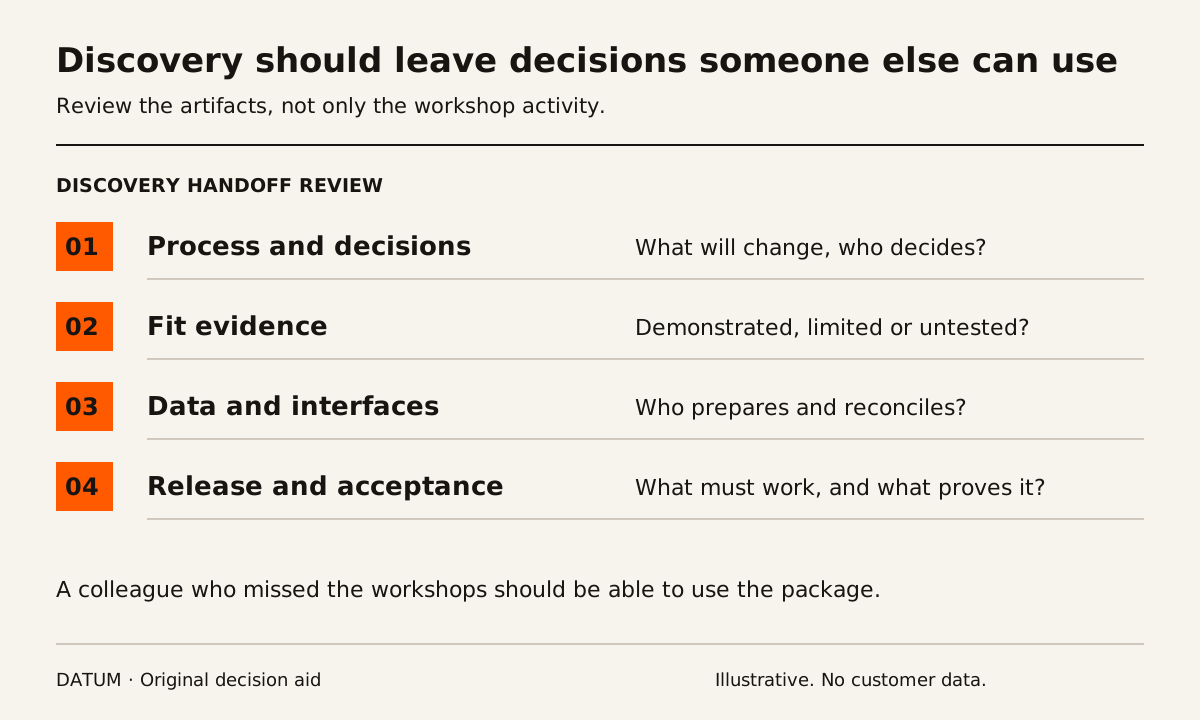
An ERP discovery engagement should leave a decision package the business can use: a bounded process design, tested fit evidence, data and integration responsibilities, unresolved questions and a release scope with acceptance conditions. Workshop attendance and a long feature list do not establish that those decisions have been made.
Agree on the package before discovery begins. The right depth depends on the decisions needed for the next commitment. A simple process may need a short evidence set; a custom manufacturing flow may require a targeted demonstration before anyone can responsibly estimate its release work.
Odoo's public GAP-analysis training separates current-state workshops, future-state validation, and phasing and budgeting. That distinction is useful when specifying discovery outputs, without adopting a fixed duration or assuming that attending a workshop completes each stage. Odoo business analysis and qualification course.
Ask what the next team could do with the result
A useful test is to give the discovery package to an authorized colleague who did not attend the sessions. Can they identify the process to implement, the decision owners, the unresolved questions and the evidence that will establish acceptance?
If the package depends on the consultant explaining everything again, locate the missing artifact. It may be a process boundary, a disputed decision, an assumption hidden in an estimate or a demonstration whose result was never recorded.
Use the process-to-requirement method to keep requirements tied to an actor, condition, outcome and proof. Discovery should clarify that chain before the implementation team chooses detailed screens or extensions.
Define an inspectable deliverable set
| Deliverable | What a reviewer should be able to establish |
|---|---|
| Process boundary | Start, accepted end, roles and important exceptions |
| Future operating decisions | Which steps change, which remain and why |
| Fit evidence | Demonstrated behavior, limitations and untested assumptions |
| Data scope | Objects, history, quality issues and cleanup owners |
| Integration boundary | Records, direction, identity, corrections and responsible system |
| Release proposal | First usable scope and later work with dependencies |
| Acceptance cases | Starting facts, user actions and expected saved evidence |
| Decision register | Accepted decisions, unresolved items, owners and consequences |
The table is an original buyer's review aid, not a claim that every vendor sells the same discovery service. Put the agreed artifacts and their acceptance conditions into the actual scope.
Separate a demonstrated fit from an attractive idea
For a fictional manufacturer, suppose discovery proposes handling an order-specific component through a controlled variant. Record whether that path was demonstrated with the required option and a subsequent ordinary order, merely discussed, or still awaiting a test.
Those states should lead to different planning confidence. A diagram of a possible workflow can support a useful conversation, but it should not be presented as completed proof of the configuration. Ask for the bounded demonstration that would remove the uncertainty.
Keep custom development conclusions equally specific. Name the unmet acceptance condition, the standard approach considered and why it did not satisfy the agreed requirement. A request for a familiar old screen is not sufficient evidence of a functional gap.
Keep unknowns visible in the implementation estimate
Give each unresolved item an owner, the evidence needed and the effect of leaving it open. Some questions can be answered during configuration without changing the release decision. Others determine whether the proposed design is feasible at all.
Do not turn unresolved history migration, interface access or engineering approval into an assumed inclusion. Ask the delivery team to state the estimate basis and the event that would require revising it. The statement-of-work guide helps carry those boundaries into delivery.
A usable package may recommend another small investigation before a larger commitment. That is a concrete outcome when the missing decision and next test are specified; it is not a reason to accept an indefinite discovery phase.
Review the package as a handoff
Have process, data and technical owners review the parts they must use. Record their accepted decisions and corrections. Then test whether the proposed first release has the necessary inputs, people and acceptance cases.
Close discovery with an agreed artifact set and an explicit decision about the next scope. Retain the evidence behind the decision so a later implementer can challenge or update it without reconstructing the original meetings. The value of discovery is the uncertainty it resolves and the remaining work it makes clear.