
Compare ERP ownership costs beyond the subscription
Build a three-year ERP cost worksheet with quoted cash costs, internal capacity and explicit scenarios. Keep unknowns and possible benefits separate.
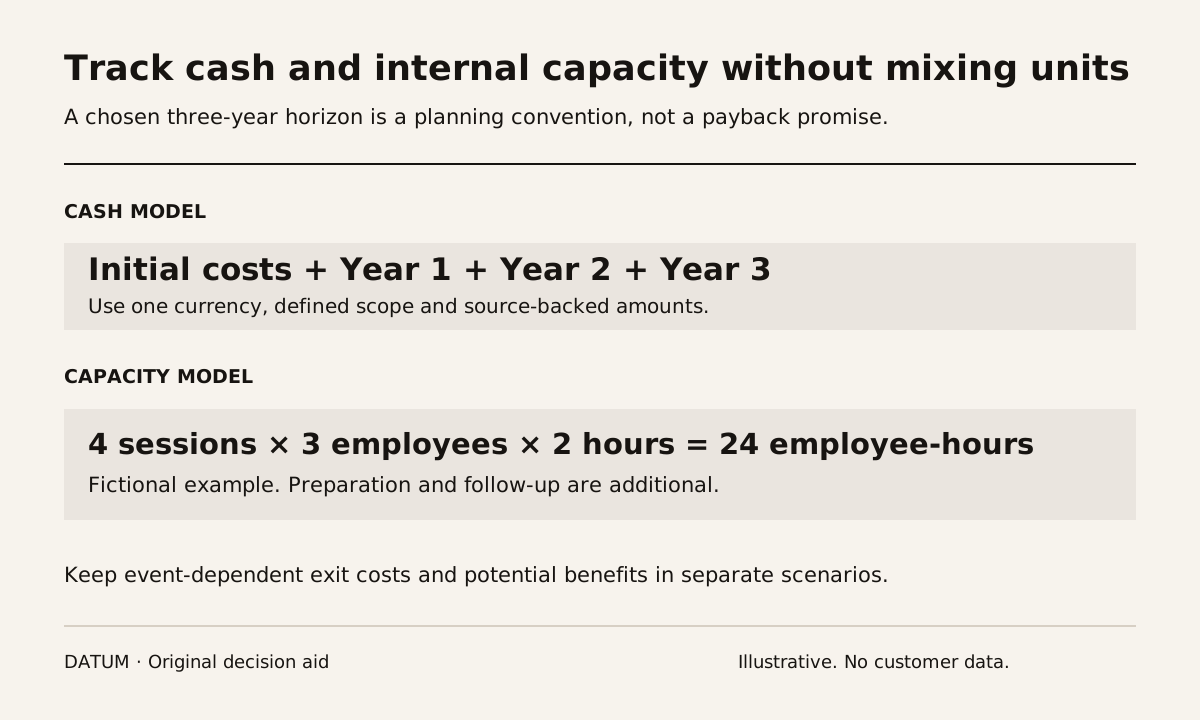
Compare ERP ownership costs over an agreed period using the same operating scope and explicit assumptions. Separate supplier cash costs from the internal time needed to decide, prepare data, test and run the system. A subscription comparison alone cannot establish the cost of reaching and maintaining a usable workflow.
Odoo's pricing page distinguishes software plans and describes implementation services separately. Its published offering is a starting point for confirming what is included in a quotation, not a complete budget for your business. Odoo plans and service boundaries.
The worksheet below uses three years as a chosen planning horizon. Three years is not a required ERP payback period or a forecast that a particular system will need replacement then.
Freeze the scope that the costs are supposed to support
Write the companies, workflows, users, locations, integrations and history included. Identify the first release and any later expansion separately. Otherwise, a lower estimate may merely exclude work that the other estimate includes.
Keep a version of this scope beside each supplier quotation. Record the currency, quotation date, pricing period and assumptions about user growth. Treat a promotion and the recurring basis after it as separate evidence to confirm, rather than extending a temporary discount through the whole model.
Use the implementation cost guide to define initial delivery components before adding ongoing ownership.
Build the cash worksheet
Use one currency and a consistent treatment of applicable charges agreed with your finance owner. Enter a source for each amount and leave unresolved amounts visibly unknown.
| Cost component | Initial change | Year 1 | Year 2 | Year 3 | Source or assumption |
|---|---|---|---|---|---|
| Software subscription | If applicable | Quoted basis | Renewal assumption | Renewal assumption | Plan, users and term |
| Implementation services | Defined scope | Later work if planned | Planned expansion | Planned expansion | Supplier scope |
| Data and integration work | Preparation and build | Support or usage | Support or usage | Support or usage | Responsibility map |
| Hosting and extensions | Setup if separate | Recurring basis | Recurring basis | Recurring basis | Included or additional |
| Maintenance and upgrades | Initial test setup | Expected work | Expected work | Expected work | Owner and service agreement |
| Exit or transition | Usually a separate scenario | Event-dependent | Event-dependent | Event-dependent | Export and handover assumptions |
Avoid double counting. If implementation includes a defined migration task, do not add a second external migration charge for the same work. If hosting is included, do not insert an additional hosting allowance without explaining why.
The arithmetic for a base cash case is initial costs plus the three annual totals. Add event-dependent costs only to the scenario where the event occurs. A blank cell is not automatically zero; mark it included, not applicable or unresolved.
Track internal capacity beside the cash model
List the hours needed from process owners, data owners, testers, trainers and administrators. Keep the source of each estimate and the point in the plan when the person is required.
For a purely illustrative capacity calculation, suppose four review sessions each need three employees for two hours. That is 4 × 3 × 2 = 24 employee-hours, before preparation or follow-up. It is not a dollar cost until the finance owner chooses a valuation method. Do not add hours directly to the cash totals.
Internal time also affects feasibility. Twenty-four hours concentrated in the same two days may create a different delivery problem from time spread across several weeks. The implementation timeline guide helps connect that capacity to dependent work.
Test the assumptions that could change the decision
Create a small number of understandable scenarios. One might hold the current user count and scope. Another might add a planned site. A third might include replacing a custom integration. Use actual business possibilities, not arbitrary percentage uplifts applied to every line.
For each scenario, change only the assumptions it affects. Additional users may change subscription cost; a new warehouse may also create data, testing and training work. Ask the supplier to confirm the applicable commercial basis without presuming that a single user-rate formula covers everything.
Keep benefits out of the cost total. If the team wants to assess savings, build a separate evidence-backed benefit model with its own baseline and confidence. A plausible reduction in manual work does not erase an invoiced expense.
Make the remaining uncertainty visible
The comparison should show the scoped cash totals, internal capacity, source dates and unresolved items. Name who must confirm each unknown before commitment. If a material cost cannot be estimated until discovery, state the bounded discovery task needed rather than filling the cell with an invented industry average.
The useful result is an ownership model someone can update when a quote or requirement changes. Its value comes from exposing what must be paid, staffed and maintained, not from making a precise-looking total out of unverified inputs.