
Read an Odoo Enterprise quote as a set of responsibilities
Compare Odoo Enterprise entitlements, hosting, delivery and ongoing ownership. Use a quote worksheet to expose missing scope before comparing totals.
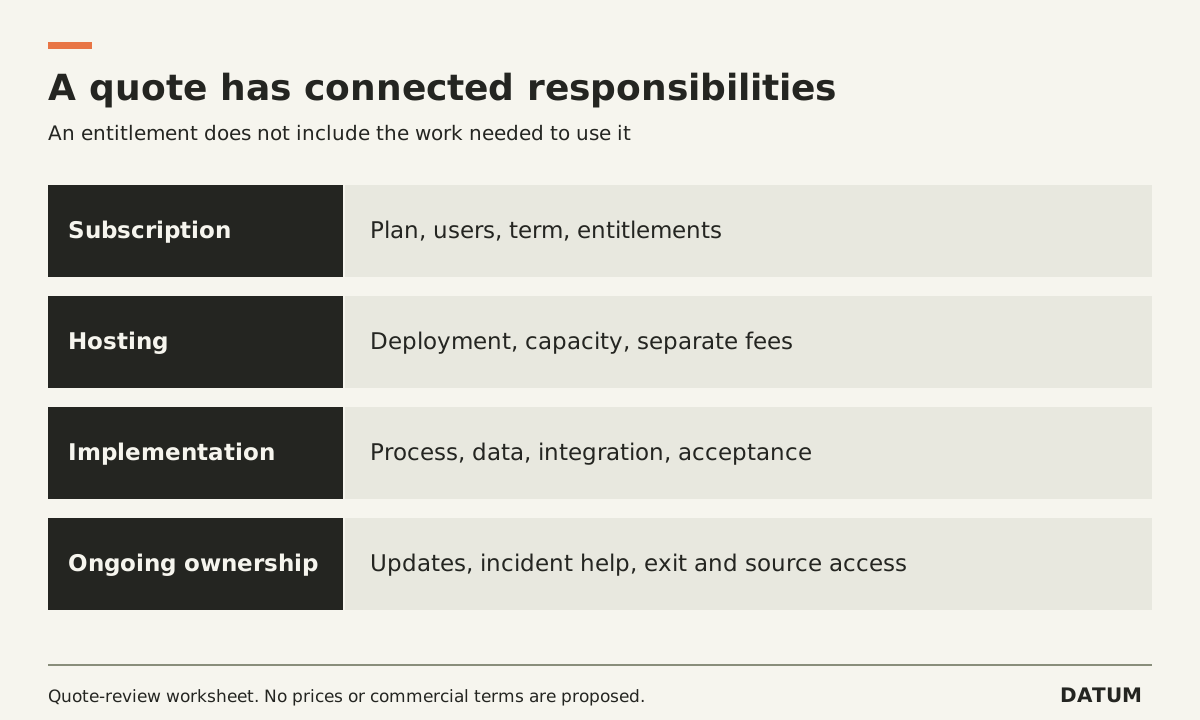
Read an Odoo Enterprise quote as several connected purchases: software entitlements, hosting, implementation, data work and ongoing responsibility. Compare those lines on the same basis before comparing the total. A per-user license figure alone does not describe the cost or scope of introducing the system.
This is a quote-review worksheet. It does not set DATUM fees, recommend a contract term or promise a current Odoo price. Obtain the vendor's written offer for your location, currency, user count, term and required deployment.
First identify what the subscription permits
At the September 22, 2026 source check, Odoo's published Standard plan lists Odoo Online, while Custom lists Odoo Online, Odoo.sh or on-premise options together with Studio, multi-company and external API access. The page separately states that Odoo.sh hosting cost is not included. Verify the current Odoo plan comparison when obtaining your quote; the commercial terms may change.
Do not infer from a plan label that a particular integration is built, supported or included. Entitlement to use an API is different from the work required to connect two systems and handle failures.
Write the required behavior beside the entitlement. For example: “The approved field-service record must reach billing, and failed transfers must be visible to the office owner.” Then identify the proposed feature, connection and support responsibility that will deliver it.
Normalize the quote before adding it up
Use the following table for each offer. Leave an unknown as unknown instead of entering zero.
| Cost or responsibility | What to capture | Question if missing |
|---|---|---|
| Software subscription | Plan, users, billing period, currency and renewal basis | What changes when users or companies are added? |
| Hosting | Included service or separate line, environment and capacity assumptions | What does the quoted deployment require? |
| Implementation | Processes, modules and acceptance evidence | What must be working at handover? |
| Data migration | Objects, cleanup owner, rehearsal and reconciliation | Which history and open records move? |
| Integration | Direction, fields, identity, failure handling and support | Who owns a failed or duplicate transfer? |
| Custom work | Deliverable, source access and maintenance responsibility | Who tests it after upgrades? |
| Training and adoption | Roles, practice tasks and follow-up | Who can demonstrate independent completion? |
| Ongoing help | Scope, response terms and exclusions | Which problems belong to the vendor or partner? |
Keep one-time work separate from recurring charges. If two offers use different contract periods, show both the original offer and a common comparison period with your assumptions. Do not multiply a temporary discount across years for which it has not been offered.
The point is not to turn an uncertain estimate into a more elaborate spreadsheet. It is to expose which missing decision could change the total.
Resolve a hosting mismatch before accepting the quote
Consider a fictional team with a proposed third-party module that requires custom Python server code. One offer assumes Odoo Online, while the implementation scope assumes deploying that code. The discrepancy needs resolution before either price is meaningful.
Odoo's 19.0 importable-module tutorial distinguishes managed hosting's custom Python restriction from XML/data modules. Have the implementer identify whether the requested behavior uses standard configuration, Studio, an external integration, an importable data module or Python server code, then confirm the applicable deployment conditions. Do not use the word “custom” as a substitute for that distinction.
Ask for a revised, internally consistent offer once the requirement is clear. A salesperson's verbal explanation should not remain the only record tying the hosting choice to the delivery scope.
Give the unknowns owners and dates
Bring unresolved rows to the vendor and implementation partner. Ask each to confirm the lines they own and identify dependencies on the other. Use the implementation scope guide for delivery work and the statement-of-work worksheet to describe acceptance.
Before making the purchasing decision, you should be able to point to the required outcome, its subscription or hosting prerequisite, its implementation owner and the evidence that will establish completion. Any row still blank is an open buying question, not an included service.