
Verify the Odoo AI feature before promising the workflow
Check the Odoo version, apps, hosting, sources and permitted action. Use an evidence card to distinguish a useful answer from a tested business workflow.
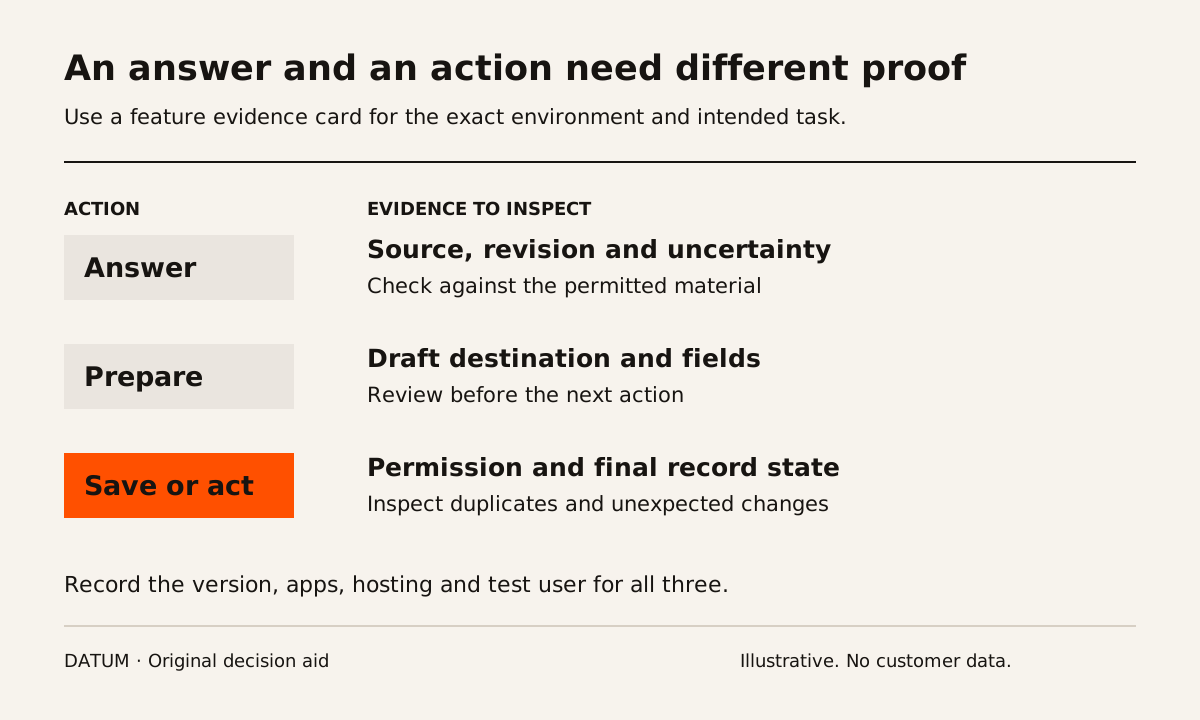
Treat an Odoo AI feature as a specific action to verify in a specific database. Before promising that it can answer a question, prepare a record or change a workflow, establish the version, installed applications, hosting arrangement, source material and permissions involved.
Odoo 19 documents AI agents built from prompts, topics, tools and sources. Creating or customizing agents requires the AI app. Available tools depend on the applications installed, and an agent without topics is limited to providing information rather than performing tasks or changing the database. Those distinctions matter more than a general statement that a business is “using AI.” Odoo 19 AI agents.
Write the proposed action as a testable sentence
“Help the sales team” does not define a test. “Given an approved product guide, answer a salesperson's compatibility question and identify the source passage” does. So does “prepare a lead from a permitted inquiry, leaving assignment for a person to review.” The second example changes records and needs a different acceptance test from the first.
Use this feature evidence card before the demonstration:
| Field | What the card must contain |
|---|---|
| Environment | Exact Odoo version, database and installed applications |
| Access | Hosting arrangement, subscription and any required extension |
| Input | The document, message or record the action may use |
| Output | An answer, a draft or a saved business record |
| Authority | The user role and permitted action |
| Review | Who checks the result before it affects the next person |
| Failure behavior | What should happen when evidence is missing or conflicting |
| Proof | Test record, observed result and unresolved limitations |
Keep the subscription and technical checks separate. A feature described in documentation does not establish that your contract, database or configuration includes it. Odoo's current pricing page distinguishes plans and hosting options. Odoo Online does not allow deployment of custom Python server code; Odoo 19 also documents importable XML/data modules as a separate customization approach. Identify which kind of extension the proposed AI workflow requires and confirm its deployment conditions. Odoo plans and Odoo 19 importable modules.
Separate knowing from doing
Imagine a fictional equipment distributor testing an assistant against an approved installation guide. The first task is to explain whether a named accessory fits a product. The second is to create an opportunity for an interested customer. They may occur in the same conversation, but they are different capabilities.
For the answer, inspect the source, the revision and what happens when the guide is silent. For the saved record, inspect the destination, customer association, fields written and permission used. A fluent explanation does not prove that the right customer record was changed.
Odoo's agent documentation distinguishes source indexing from tool configuration. It also describes a “Restrict to Sources” option. Treat that setting as part of the configuration to test; it does not remove the need to check the answer against the source. Odoo 19 agent sources and tools.
Use the AI data permission guide to define what the test user may read and change. A demonstration under an administrator account cannot establish how an ordinary employee's access behaves.
Challenge the feature with four inputs
Prepare a small, authorized test set that exposes different failure modes:
- A clear question with a current source that contains the answer.
- A question whose answer is absent from the permitted sources.
- A question with two documents that disagree, including their revision dates.
- A request to perform an action outside the intended workflow.
Write the expected handling before running the cases. For the missing answer, that may be an explicit uncertainty and referral. For conflicting revisions, it may be a request for the document owner to resolve the conflict. These are proposed acceptance conditions, not claims that a default agent already follows them.
When the test can create records, use a safe test environment and inspect the database after the conversation. Check for duplicates after a repeated request, unexpected field changes and actions taken before review. Save the input and the final state, not just an attractive screenshot of the reply.
Decide what the evidence permits you to promise
Finish the card with one of three statements: demonstrated in the intended environment; demonstrated with a stated limitation; or not demonstrated. Name the limitation precisely. “Answers from the approved guide, but does not create records” is more useful than “partially ready.”
Then measure the chosen workflow using the AI pilot measurement method. Include the time spent checking and correcting outputs. If the review effort consumes the expected saving, narrow the task or improve the input before adding actions. The result of this exercise is a bounded operating capability that someone can reproduce, with a clear owner when the software cannot decide.