
An AI production proposal still has to fit the available work
Test AI production proposals against materials, capacity, sequence and permissions. Use a worked overload example and a plan for changed inputs.
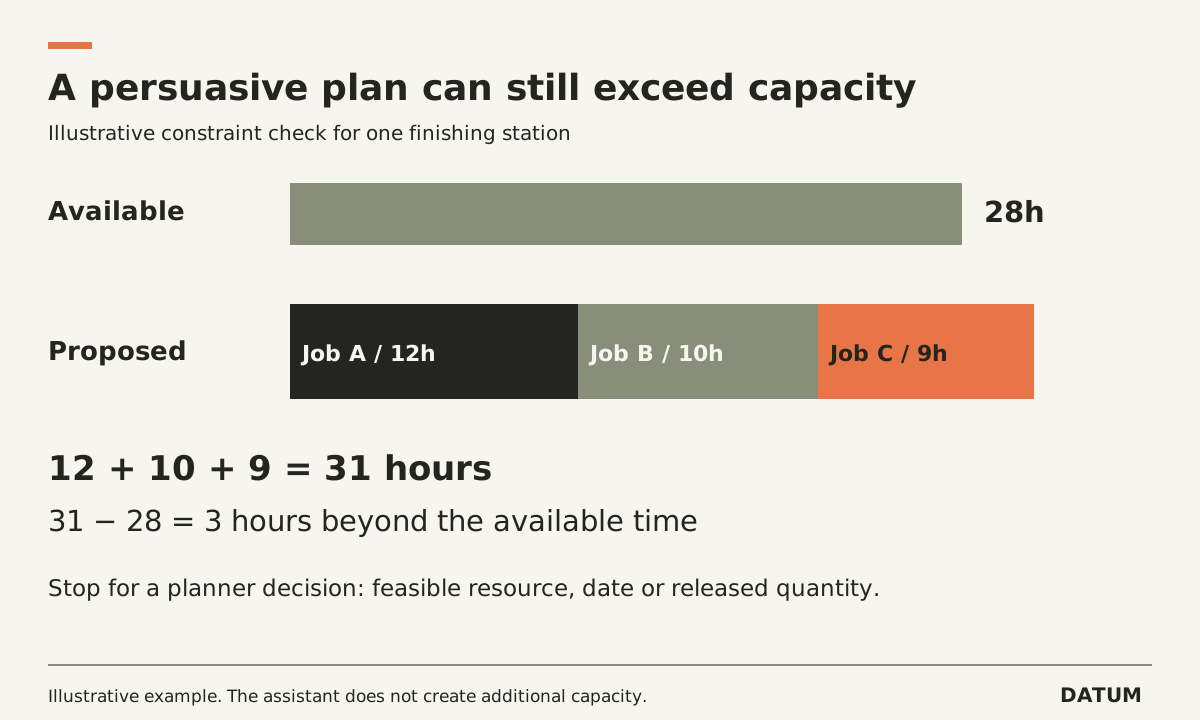
Let an AI assistant prepare a production-plan proposal only after you define the constraints a valid plan must satisfy. Keep material availability, resource capacity, operation sequence and release authority outside the assistant's unsupported judgment. A fluent explanation of a schedule does not establish that the schedule can run.
A useful first pilot is a comparison of proposed sequences in a copy of planning data. The planner retains the decision, and the pilot cannot release work or change a customer's promised date.
Define the proposal and the decision separately
Suppose a fictional workshop wants help comparing the order of three jobs at a shared finishing station. The assistant may explain alternative sequences and identify records it needs. It may not invent a missing setup time, assume an absent employee is available or silently consume material reserved for another order.
Give each input a source, timestamp and unit. “Six available” is not adequate if the planner cannot tell whether it means six pieces, six packs or six hours. Distinguish material physically on hand from supply expected later, and identify which evidence makes that supply usable for the proposal.
| Constraint | Input the checker needs | What should stop the proposal |
|---|---|---|
| Material | Required quantity, usable quantity, reservation and arrival evidence | Unexplained shortage or conflicting reservation |
| Capacity | Resource calendar, existing load and operation duration | Work exceeds available resource time |
| Sequence | Required predecessor and approved revision | A dependent step starts before its prerequisite |
| Labor | Required qualification and confirmed availability | Missing qualified coverage |
| Commitment | Due date and authority to change it | Proposal silently changes a promise |
| Data freshness | Source timestamp and known later changes | Inputs no longer describe current work |
These are proposed controls, not a description of a built DATUM product or a feature every planning system includes.
Recalculate one conflict without the assistant
Use an illustrative capacity case: a station has 28 hours available. Three proposed jobs need 12, 10 and nine hours. Their total is 31 hours, so the proposal exceeds the available time by three hours.
That arithmetic should fail even if the assistant says the sequence is efficient. The planner must resolve the constraint through an authorized change: another feasible resource, a different date or a smaller released quantity. Ask the assistant to explain the tradeoff only after the underlying alternatives are valid.
For Odoo 19.0 Enterprise, the documented work-center inputs include working hours, efficiency, setup, cleanup and product-specific capacity. Verify the relevant configured values rather than asking an AI to infer them from a general description of the plant. See the Odoo work-center reference and the capacity worksheet.
Include a change after the proposal is prepared
Prepare a valid proposal, then mark one required material unavailable in the test data. The assistant's old answer should no longer be eligible for approval. Record what detects the change and how the planner obtains a fresh proposal.
Also test a missing input. A useful result identifies the missing information and stops at that boundary. Filling the gap with a plausible estimate should be an explicit, labeled human decision, not hidden model behavior.
The NIST AI Risk Management Framework is a voluntary framework for managing AI risks across design, use and evaluation. The test sequence here is DATUM's proposed application of that general discipline; it is not NIST certification or a claim that following this worksheet makes production decisions safe.
Decide whether the pilot helps the planner
Measure accepted proposals, corrected proposals, review effort and reasons for rejection. Count the time needed to collect clean inputs and investigate errors. Use the AI pilot measurement guide so preparation and checking do not disappear from the comparison.
Before increasing scope, require the planner to reconstruct one accepted proposal from its inputs and checks. If the result cannot be explained without trusting the assistant's narrative, keep it in the pilot. The next improvement may be cleaner capacity or material records, even when the original request was for better AI.