
AI estimating: keep extracted quantities separate from scope
Review AI estimating with a source ledger, visible calculations and explicit assumptions. Test corrections before a draft quantity becomes approved scope.
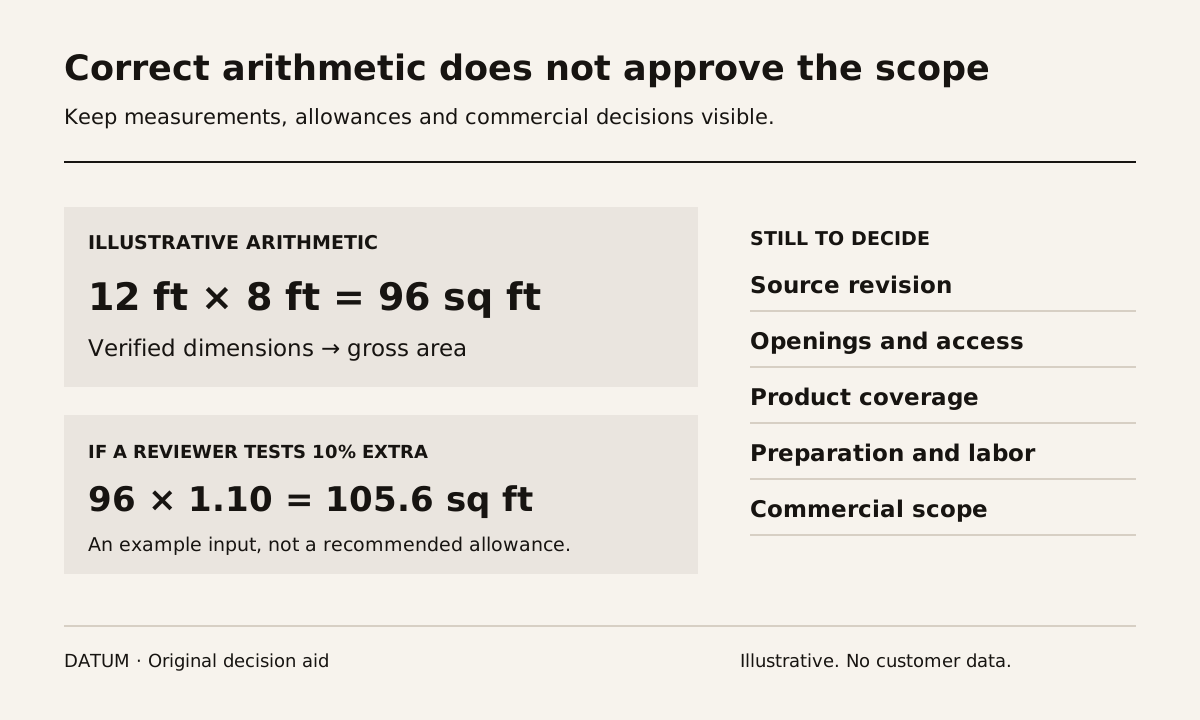
Use AI estimating output as a draft with traceable inputs. An extracted dimension or counted item does not establish the scope you are agreeing to perform. Keep measurement, interpretation, waste assumptions, labor assumptions and commercial approval distinct until the responsible estimator has checked them.
This is a proposed review method for a pilot, not a claim that a particular AI product can measure a building, interpret every drawing or prepare a reliable quote. NIST's voluntary AI Risk Management Framework provides broader guidance for considering trustworthiness during AI design, use and evaluation. It does not validate this estimating workflow or any vendor's accuracy. NIST AI Risk Management Framework.
Give every draft quantity an evidence trail
Choose a permitted, representative estimate with source material the reviewer can inspect. Keep the source revision fixed for the test. If the model sees a drawing, photograph or survey, record which file and which location support each extracted fact.
Use an estimate evidence ledger with the following columns:
| Field | Purpose | Example of a useful entry |
|---|---|---|
| Source | Identifies the actual input | Drawing A-2, revision C, marked room |
| Observed fact | Preserves what the source shows | Two labeled dimensions and their units |
| Derived quantity | Shows the calculation | Length multiplied by width |
| Assumption | Identifies what the source does not establish | No deduction made for an unmeasured opening |
| Scope decision | States what work is included | Surface preparation requires review |
| Review result | Records correction or acceptance | Dimension confirmed; allowance unresolved |
Keep unavailable evidence unavailable. A blurred label should not become a precise dimension because the output format expects a number. Define how the tool should flag unreadable or conflicting inputs, then test that behavior.
The AI data permission guide helps establish which customer documents may enter the pilot and who may access its results. Use fictional or approved material when those permissions are unresolved.
Keep the arithmetic separate from the scope
Here is a fictional arithmetic example, unrelated to an actual property or estimate. A rectangular surface has verified dimensions of 12 feet by 8 feet. Its gross area is 12 × 8 = 96 square feet. If a reviewer deliberately tests a 10% material allowance, the calculation is 96 × 1.10 = 105.6 square feet.
That 10% is an illustrative input, not a recommended allowance. The arithmetic does not establish product coverage, package rounding, openings, substrate condition, access, removal, protection, waste or labor. Each applicable item needs its own source or approved assumption.
Ask the pilot to keep three values distinguishable: measured quantity, adjusted material quantity and proposed billable scope. If the tool returns only one total, the reviewer may not be able to tell whether an error came from extraction, a formula or an unsupported assumption.
Do not infer that a photograph reveals concealed conditions. Record what needs a site check or another source. Any engineering, code or safety determination belongs with the qualified person responsible for that decision, outside this draft quantity exercise.
Design the test around corrections
Prepare a reviewed reference for a small set of representative cases. Include a clear source, a missing dimension, a revised drawing and a case where the visible quantity is correct but the proposed work is incomplete. The last case is important: correct multiplication can coexist with an unusable scope.
Compare the draft against the reference one line at a time. Classify each correction as a source-reading error, a unit error, a formula error, an unsupported assumption or missing work. Keep the original output and the corrected version so repeated weaknesses remain visible.
Measure the full review effort using the AI pilot measurement guide. Include the time needed to locate sources, resolve assumptions and repair the draft. Producing a total quickly does not establish that the estimating process became faster or more dependable.
Keep a clear boundary before a customer sees the result
For the pilot, make the output a working estimate with a named reviewer. Define which unanswered questions stop release and which can remain as explicit, approved assumptions. Do not let the tool silently turn its own guess into an exclusion or a customer commitment.
A useful handoff contains the reviewed quantities, the source revision, the accepted assumptions, unresolved site questions and the person who approved the commercial scope. If the source changes, identify which lines need another review rather than treating the earlier approval as permanent.
The first pilot can succeed without preparing an entire quote. It may simply produce a well-sourced draft of a narrow quantity list that an estimator can check efficiently. Expand only when the evidence shows which part of the work is reliable, which errors recur and where a person must still decide.